


2002 · The Streak
Hatteberg Walk-Off HR — Win #20
Nine World Series titles. A century of baseball. From Connie Mack's dynasty to Moneyball's revolution, from the Swingin' A's to the final game at the Coliseum — the definitive history of the most fascinating franchise in American sports.
1972 · 1973 · 1974 — Three straight World Series titles. The only team besides the Yankees to do it. Mustaches, fighting in the clubhouse, and the greatest pitching staff ever assembled.
They wore white cleats, grew handlebar mustaches, fought each other in the clubhouse, and won three straight World Series titles. Besides the New York Yankees, no team in baseball history has ever three-peated. The Oakland A's of the 1970s remain one of the most colorful and dominant dynasties the sport has ever seen.

Catcher Gene Tenace was barely a household name entering the 1972 Fall Classic against Cincinnati's Big Red Machine. He promptly hit home runs in his first two at-bats — the first player ever to do so in a World Series — and finished with four total, tying the records held by Babe Ruth and Lou Gehrig. Joe Rudi's spectacular game-saving catch against the wall in Game 2 preserved a one-run lead, and the A's won Game 7 by a score of 3-2. Tenace was named World Series MVP.
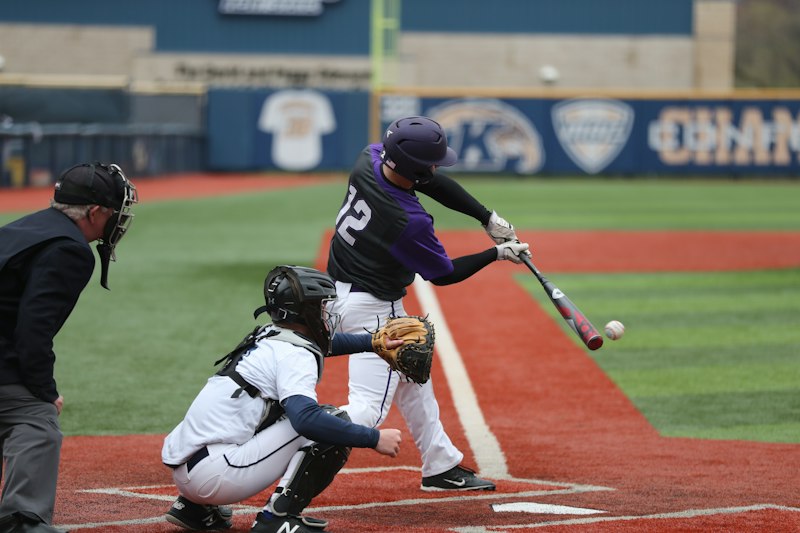
The 1973 World Series went the full seven games against the Mets, and the A's proved they were no fluke. Bert Campaneris and Reggie Jackson each launched two-run blasts in the deciding game. Relief pitcher Darold Knowles made history as the first pitcher to appear in all seven games of a World Series. Two down, one to go.
The A's dismantled the Dodgers in five games to complete the three-peat. Rollie Fingers — the man with the most famous handlebar mustache in sports history — earned World Series MVP honors. It was the kind of dominance that shouldn't have been possible with a roster of players who reportedly couldn't stand each other. Manager Dick Williams had already quit after 1973; Al Dark guided them to the final crown.
Threw a perfect game in 1968, then won three straight World Series rings. The ace of the staff who left after 1974 via free agency — the first crack in the dynasty's foundation.
Hall of FameThe handlebar mustache that closed out a dynasty. Three World Series rings, 1974 WS MVP. Revolutionized the closer role and became one of the most iconic relievers in baseball history.
Hall of Fame"Mr. October" before he earned that nickname in New York. Hit .262/.358/.490 with 269 home runs in Oakland. The emotional, charismatic engine of the dynasty — then traded to Baltimore in 1976.
Hall of FameWon the AL MVP and Cy Young in 1971 at age 21. The left-handed fireballer was the most electrifying young pitcher of his era. Traded to the Giants in 1978 — another star lost.
MVP + Cy Young 1971Jose Canseco. Mark McGwire. Forearms the size of tree trunks. 1988-1990: back-to-back-to-back pennants, one earthquake, and the most feared lineup in baseball.
Jose Canseco and Mark McGwire. Two massive sluggers who celebrated home runs with a forearm bash at home plate. They powered Oakland to three straight pennants — and one of the most surreal World Series in history.
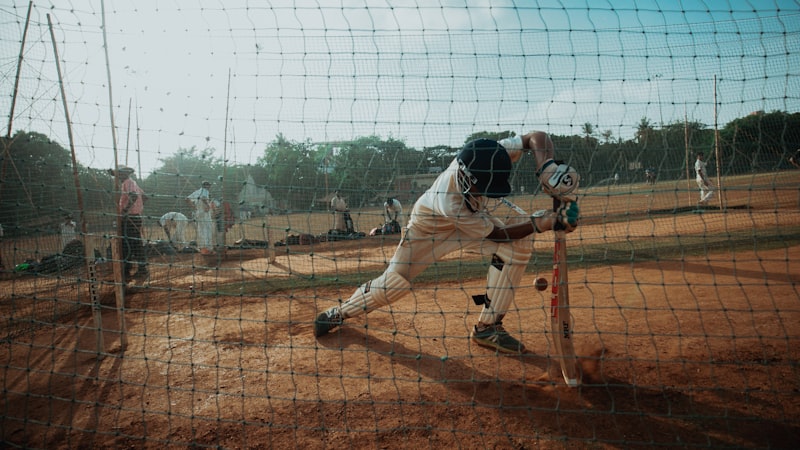
In 1988, Jose Canseco became baseball's first 40-40 player — 42 home runs and 40 stolen bases — winning the AL MVP. McGwire had slugged 49 homers as a rookie the year before. Together, they were the most feared duo in baseball and carried the A's to the American League pennant. Then came Kirk Gibson.
Gibson's iconic walk-off home run in Game 1 of the 1988 World Series — limping to the plate, pumping his fist rounding the bases — crushed Oakland's dreams. The Dodgers won in five. It remains the most famous World Series moment of the decade.
The 1989 World Series between the A's and Giants was supposed to be a celebration of Bay Area baseball. Before Game 3 at Candlestick Park, a 6.9-magnitude earthquake struck, killing 63 people and delaying the Series for ten days. When play resumed, the A's completed a devastating four-game sweep.
Dennis Eckersley's fist pump as he closed out Game 4 became an iconic image. Dave Stewart won Series MVP. It was Oakland's most dominant postseason performance — and the last time they'd lift the Commissioner's Trophy.

The Bash Brothers era couldn't escape the steroid cloud. Canseco admitted to using performance-enhancing drugs in his 2005 tell-all book, and McGwire's home run records — including the 70 he hit in 1998 after being traded to the Cardinals — remain tainted. Canseco was traded to Texas in 1992; McGwire to St. Louis in 1997. Both departed before their peak power numbers. The pattern was already emerging.
$40 million payroll. 103 wins. 20 straight. Billy Beane proved you don't need money to win — you need math. Then he proved you can't win in October with just math.
Billy Beane didn't have money. So he changed the game. Armed with sabermetrics, a bottom-five payroll, and the audacity to value on-base percentage over batting average, the Oakland A's built a model that reshaped how every front office in professional sports thinks about talent.
Same wins. One-third the cost. That's the Moneyball thesis in one chart.

On September 4, 2002, Scott Hatteberg — a converted catcher who couldn't throw — stepped to the plate in the bottom of the ninth with the A's trailing. He launched a walk-off home run to complete the 20th consecutive win, an American League record. The crowd at the Coliseum erupted. The streak — and Hatteberg's moment — became the emotional climax of both the Moneyball book and the 2011 Brad Pitt film.

Barry Zito won the Cy Young in 2002. Tim Hudson was the model of consistency. Mark Mulder rounded out what became known as "The Big Three" — a homegrown rotation built through the draft, the Moneyball way. They anchored four straight playoff appearances from 2000 to 2003. Then, predictably, they were all gone: Hudson traded to Atlanta, Mulder to St. Louis, Zito departed as a free agent to the Giants. The pattern repeated.
Oakland won like a $2 billion franchise while spending $840 million — generating $1.18 billion in surplus value. No franchise in baseball did more with less.

Build a contender. Develop stars. Trade them before they get expensive. Watch them thrive elsewhere. Repeat. For half a century, this has been the Oakland Athletics' inescapable cycle — a franchise cursed by its own brilliance at finding talent it can never afford to keep.
| Player | Departed | Destination | What Happened Next | Pain Level |
|---|---|---|---|---|
| Reggie Jackson | 1976 | Baltimore → NYY | Became "Mr. October," 3 HR in WS Game 6 | ■■■■■ |
| Vida Blue | 1978 | San Francisco | Still productive, dynasty fully dismantled | ■■■■ |
| Rickey Henderson | 1984 | New York Yankees | Became all-time steals king, returned later | ■■■■■ |
| Jose Canseco | 1992 | Texas Rangers | Still slugging, A's dynasty over | ■■■ |
| Mark McGwire | 1997 | St. Louis Cardinals | Hit 70 HR the very next season | ■■■■■ |
| Jason Giambi | 2001 (FA) | New York Yankees | Won MVP his last Oakland year, got $120M | ■■■■■ |
| Tim Hudson | 2004 | Atlanta Braves | Big Three gone; 222 career wins total | ■■■■ |
| Mark Mulder | 2004 | St. Louis Cardinals | Injuries ended career, but departure gutted rotation | ■■■ |
| Barry Zito | 2006 (FA) | San Francisco Giants | $126M deal, won WS ring with Giants in 2012 | ■■■■ |
| Nick Swisher | 2008 | Chicago White Sox | Solid years with Yankees/Indians | ■■ |
| Carlos González* | 2008 | Colorado (Holliday trade) | 3x All-Star, Gold Glove — for 93 games of Holliday | ■■■■■ |
| Yoenis Céspedes | 2014 | Boston Red Sox | Got Jon Lester rental; Lester went to Cubs | ■■■■ |
| Josh Donaldson | 2015 | Toronto Blue Jays | Won AL MVP immediately in Toronto | ■■■■■ |
| Matt Chapman | 2022 | Toronto Blue Jays | 2x Platinum Glove, franchise 3B traded away | ■■■■ |
| Matt Olson | 2022 | Atlanta Braves | Hit 54 HR his 2nd year with Atlanta | ■■■■■ |
| Sean Murphy | 2022 | Atlanta Braves | All-Star catcher, franchise piece moved | ■■■■ |
| Frankie Montas | 2022 | New York Yankees | 2022 fire sale — total teardown begun | ■■■ |
Reggie. Rickey. Catfish. Fingers. Eckersley. They wore the green and gold, and they're immortal.
Six legends enshrined in Cooperstown wearing the green and gold. Each one defined an era, changed how the game was played, and — true to form — eventually left Oakland.
The most charismatic player of his generation. Reggie's power, personality, and postseason heroics made him a superstar in Oakland before he became "Mr. October" in New York. Three World Series rings with the A's. Traded to Baltimore in 1976 in a move that still stings.
The greatest leadoff hitter and base stealer in the history of the sport. His 130 stolen bases in 1982 is a record that may never be broken. Rickey was Oakland through and through — born in Chicago, raised in Oakland, and always came back. The A's retired his number in 2009.
Pitched a perfect game on May 8, 1968 — then won three straight World Series titles. A's owner Charlie Finley gave him the nickname "Catfish" to make him more marketable. Became baseball's first big free agent when he left for the Yankees after 1974, cracking open the dynasty.
The handlebar mustache. The ice-cold composure. Three World Series rings and the 1974 WS MVP. Fingers didn't just close games for the dynasty — he helped define what a closer was supposed to be. His mustache remains the most famous piece of facial hair in baseball history.
Reinvented himself from a washed-up starter to the most dominant closer in baseball. His 0.61 ERA in 1990 remains one of the most absurd single-season stats ever recorded. Won both the Cy Young and MVP in 1992. His fist pump closing out the 1989 World Series is forever burned into Oakland memory.
Managed the first two championship teams of the dynasty before quitting after the 1973 World Series — unable to tolerate owner Charlie Finley any longer. Inducted into the Hall of Fame in 2008 wearing an A's cap.
September 26, 2024. 46,889 fans. One last game. The end of 56 years. Barry Zito sang the anthem. Rickey threw the first pitch. And then it was over.
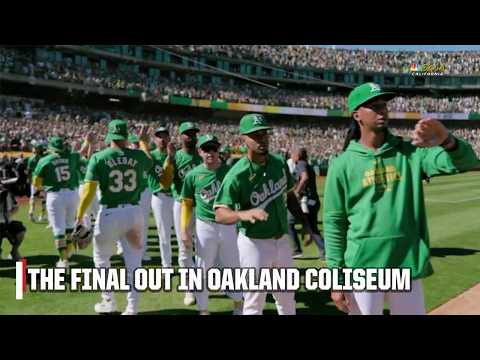
The final game. 46,889 fans packed the Oakland Coliseum — the largest farewell crowd in baseball history — to say goodbye to 57 years of A's baseball. They came to mourn, to celebrate, and to make sure Oakland wouldn't go quietly.
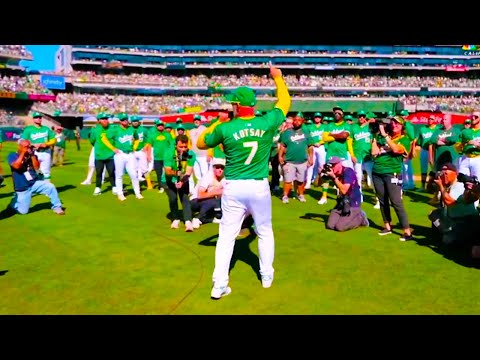
They won. Of course they won. In a season that produced a 69-93 record and "Sell the Team" chants that echoed through the Coliseum all summer, the A's gave Oakland one last victory. The players took a victory lap around the field. Manager Mark Kotsay addressed the crowd. Grown men wept openly in the stands.
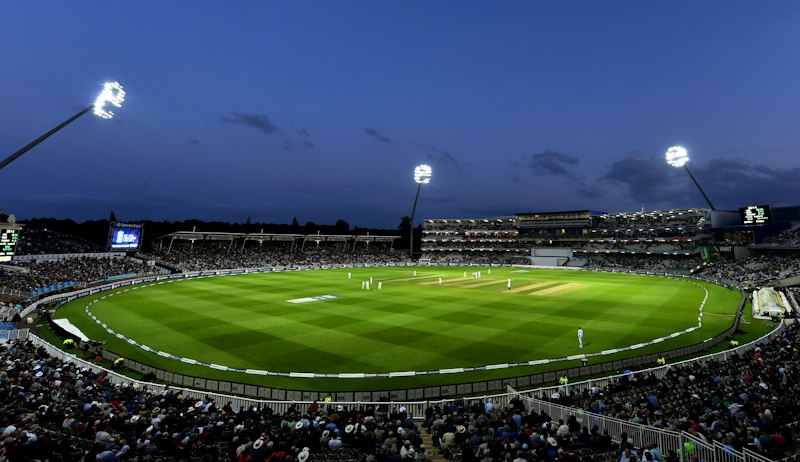
All season, fans organized "reverse boycotts" — deliberately packing the stadium to show the world (and ownership) what Oakland could have been. The final homestand was a week-long wake. Barry Zito returned to sing the national anthem. Rickey Henderson and Dave Stewart threw ceremonial first pitches. Every era of A's history was represented.
And through it all, the chants: "Sell the Team. Sell the Team. Sell the Team." Directed at owner John Fisher, whose family wealth from The Gap couldn't apparently extend to keeping a team in Oakland.
The 2024 A's were built to lose, a skeleton crew roster on a minimum payroll. But the players played hard. Every home game in the final months felt like a memorial service that occasionally featured baseball.
Barry Zito sang the anthem. Rickey Henderson and Dave Stewart — two of the greatest to wear the green and gold — threw out first pitches. Hall of Famers, role players, and cult heroes all came back for one last night under the Coliseum lights.
The A's play at Sutter Health Park in Sacramento (2025-2027), a 14,000-seat minor league stadium, before moving to a new 33,000-seat retractable-roof stadium in Las Vegas targeted for 2028. Oakland is left with an empty Coliseum and memories.
From a crumbling Coliseum shared with football to a minor league park in Sacramento to a billion-dollar Vegas palace — the Oakland Athletics' stadium story is a cautionary tale of civic neglect, political failures, and corporate greed.
The numbers tell a story of a franchise that consistently punched above its weight. Here's the data behind the legend.
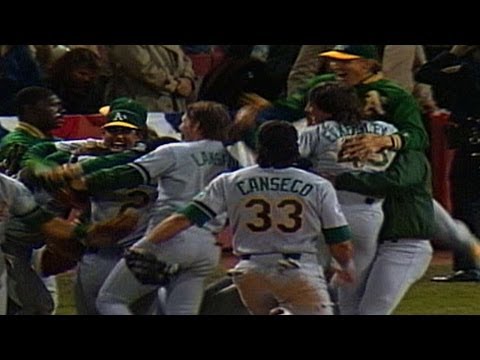
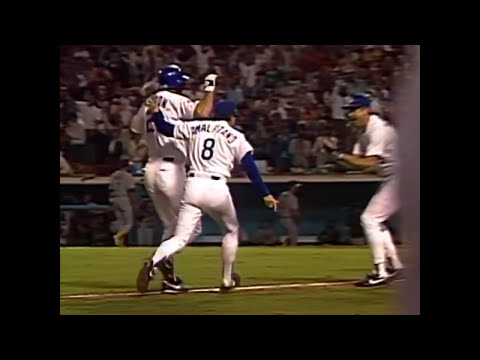
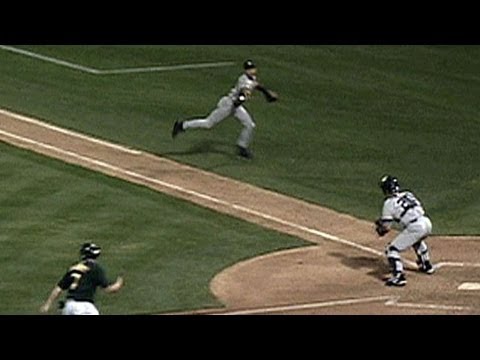
The greatest A's moments, all in one place. From Hatteberg's walk-off to Jeter's Flip, from Eck's fist pump to the final goodbye — relive them here.


No franchise has permeated American pop culture quite like the A's. From a Best Picture-nominated film to Andy Samberg rapping about steroids, Oakland's story has been told and retold across every medium.
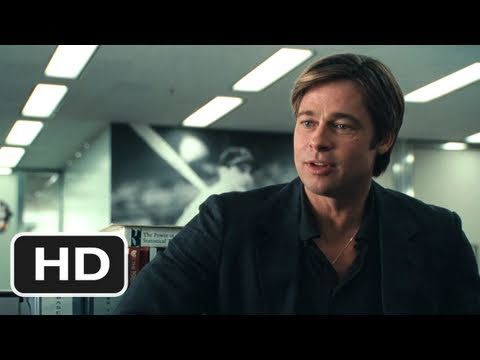
Brad Pitt stars as Billy Beane in the adaptation of Michael Lewis's 2003 book about the 2002 Oakland A's season. Directed by Bennett Miller, written by Aaron Sorkin and Steven Zaillian. Jonah Hill plays a composite character based on Paul DePodesta. Philip Seymour Hoffman is manager Art Howe. Chris Pratt plays Scott Hatteberg.
Six Academy Award nominations including Best Picture, Best Actor (Pitt), and Best Supporting Actor (Hill). The film that turned sabermetrics into a household concept and made Billy Beane the most famous GM in sports history.
Andy Samberg and Akiva Schaffer star in this absurdist Netflix comedy special as Jose Canseco and Mark McGwire. A satirical visual album celebrating (and mocking) the steroid-era Bash Brothers with rap songs, skits, and delirious 80s nostalgia. Equal parts loving tribute and fever dream.
Comedy SpecialLisa Simpson manages Bart's Little League team using sabermetrics in this direct parody of Moneyball. She relies entirely on analytics, benching players based on data over instinct — until she learns that baseball sometimes defies the numbers. A pitch-perfect satire of the A's philosophy.
TV EpisodeIn multiple episodes, the stoic Captain Raymond Holt reveals that Moneyball is his all-time favorite movie — fitting for a character defined by logic, efficiency, and data-driven decision-making. The running joke perfectly captures why the A's story resonated beyond baseball.
TV ReferenceDocumentary chronicling the mustached, brawling, three-peating Oakland A's of the 1970s. Features interviews with players, managers, and owner Charlie Finley's eccentricities — including paying players bonuses to grow facial hair and bringing a mule named "Charlie O" as a team mascot.
DocumentaryThe 1989 World Series earthquake happened during the ABC pre-game broadcast, making it one of the most-watched natural disasters in television history. Al Michaels' narration of the shaking Candlestick Park became iconic. The footage appeared in countless documentaries and sports retrospectives.
Historic BroadcastCanseco and McGwire's forearm bash became one of the most imitated celebrations in sports. The duo appeared in countless TV shows, commercials, and became the face of late-80s baseball excess. Their legacy — complicated by PED revelations — remains a cultural touchstone for an era.
Cultural IconFive deep dives into the moments, decisions, and heartbreaks that defined Oakland Athletics baseball.
They hated each other. They fought in the clubhouse. Their owner was a madman. And they won three straight World Series titles anyway.

The revolution that transformed every front office in professional sports — built on a team that could never quite win in October.

Josh Donaldson won MVP the year after they traded him. Matt Olson hit 54 home runs. The pattern never changes.
A World Series interrupted by a 6.9-magnitude earthquake, resumed ten days later, and won by Oakland in a four-game sweep.
46,889 fans filled the Coliseum one last time. They won 3-2. Then they turned out the lights on 57 years of Oakland baseball.
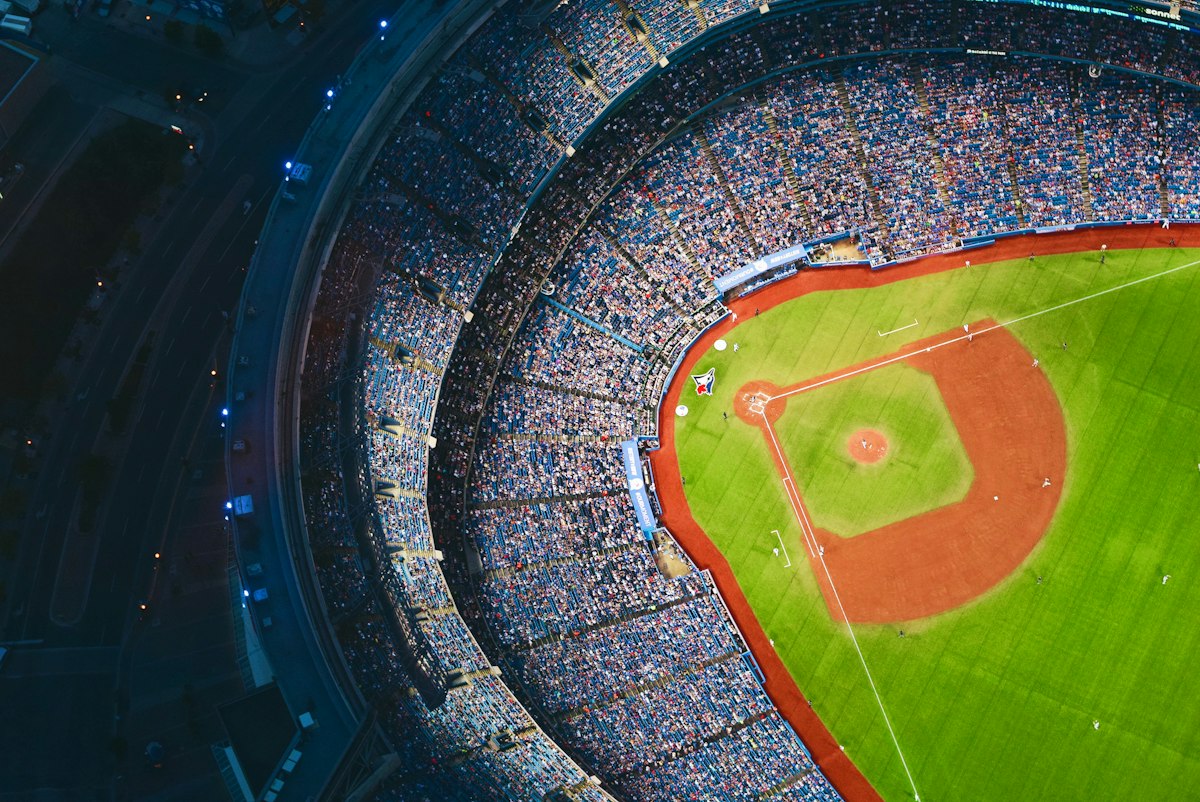
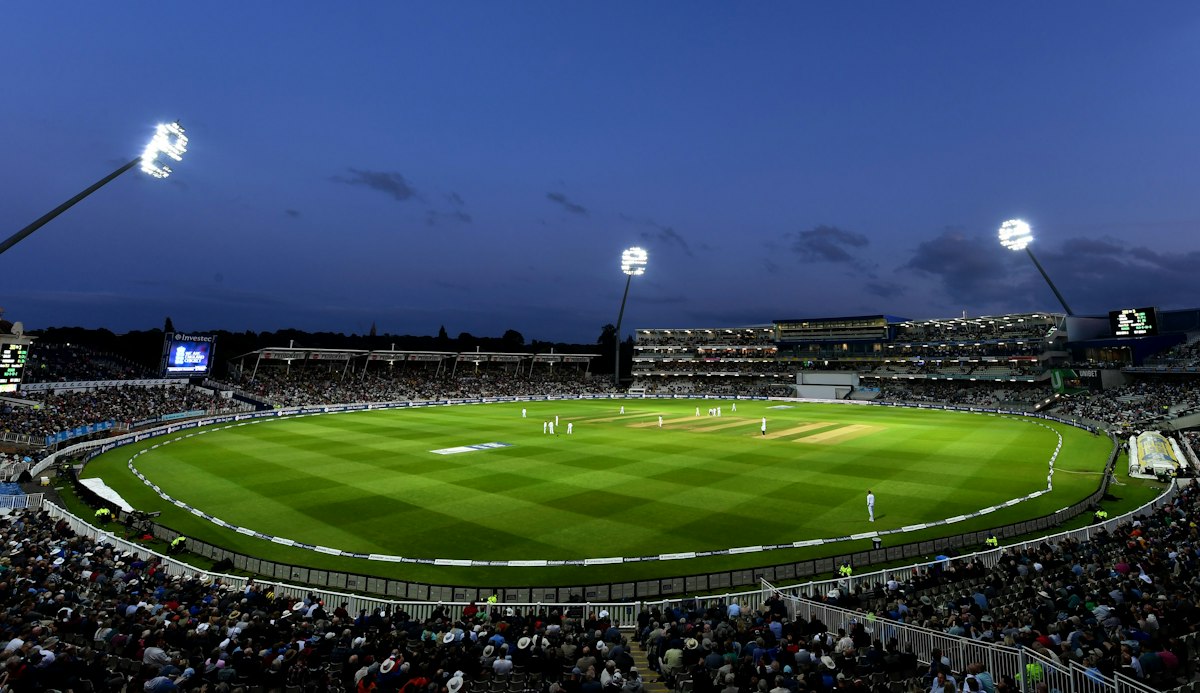
Not every story about the A's belongs in a history book. Some belong in a scrapbook. These are the games I was at, the moments I saw with my own eyes, and the three times I got to stand on that field. This section is personal — and it's going to grow.
I was there for the most iconic moment of the Moneyball era. Down big, the A's came back, and Hatteberg launched the walk-off to seal win number 20. The Coliseum exploded. That home run became the climax of a movie. I saw it live.
Moneyball MomentThe A's finally got past the ALDS — sweeping the Twins — only to get swept right back by the Tigers in the ALCS. I was there to watch the window close. The crowd still had hope that year.
PostseasonAfter a magical regular season where they came from behind to win the division, the A's lost to Detroit in the ALDS. The Tigers had Justin Verlander. It wasn't fair.
PostseasonThree times the Tigers. Three times the heartbreak. At a certain point you start to wonder if the baseball gods are just messing with you personally.
PostseasonThe fan movement that proved Oakland deserved baseball. We packed the stadium on purpose — not to support ownership, but to show the world what John Fisher was throwing away. The loudest "Sell the Team" chants I've ever heard.
The MovementNot all protest happened inside. I was part of the crowd outside the Coliseum too — making sure ownership couldn't ignore us whether we were buying tickets or not. The signs, the chants, the community. Oakland showed up.
The MovementI was one of the 46,889. Oakland 3, Texas 2. Barry Zito sang the anthem. Rickey and Stew threw out the first pitches. The players took a victory lap. Kotsay addressed the crowd. People cried. I cried. The lights went out on 57 years of Oakland baseball, and I was there to see every last second of it.
The Last NightThree times I got to stand on the actual field at the Oakland Coliseum. Not in the stands — on the grass, the dirt, under those lights.
This section will grow.
Thomas has a scrapbook of ticket stubs, photos from every era of A's and Raiders games at the Coliseum. Scans and photos are coming. Every ticket has a story. Every story belongs here.