1n2 Monthly — October 2026: the month of the correction
October left sixteen commits in the repository, which for a place that mostly lives uncommitted is close to a downpour. Read them in a row and nearly all of them are about one thing: getting a report right in public. Earthcoin on the fourteenth, Betting on the Future on the twenty-third, the Thomas Hunt history page on the twenty-fourth and the Joey coin on the twenty-fifth. The file times fill in the rest of the month, and they tell a story that moved in clear stages: promotions and devices in the first fortnight, rules in the middle, manuscripts and bookkeeping at the end.
Corrections, then a rulebook, then more corrections
The month's best writing is in its commit messages. Earthcoin went up as an archive search across four shows, thirty-six mentions from 2014 to 2022, and within the same day it carried a CORRECTION in capitals: an earlier pass had decided no photo of the Earthcoin pin survived, because the test for whether an old tweet was still live was the wrong test for retweets. Rerun properly, ten of twelve were alive and two showed the pin. That afternoon the mistake became a rule, in a house conventions document with links on everything, a dead-link policy and a section on liveness-test traps. Nine days later Betting on the Future, a history of prediction markets from 1988 to 2026, shipped with its own link checker and mobile smoke test, and then took a second commit of corrections from an adversarial review. Within two days a long-told bit about a Joey coin was traced to Andreas Antonopoulos rather than Thomas, and a Coin Rivet interview was moved from 2020 back to April 2019. Every one of those fixes made the record less convenient and more true. That is the archivist temperament written down and then obeyed.
What shipped to the front door
On the ninth, two directories came off the sweep's waiting list in a single sitting: Joshvania, a cartoon side-scroller that runs one academic career end to end, and Stackscope, an NES Tetris lab that plays your own run back to you as numbers. Two screenshots, a front-page rebuild, the roster and the deploy allow-list all moved inside ninety seconds, which is the whole publishing mechanism of this place in one breath. Two days earlier PageVoice got a native package for BOOX e-readers, the device it was always imagined on. Artist Fighter reached version 1.7.0 on the seventeenth with gamepad support on iOS Safari, two pads meaning local two-player, and two days later gained a painter sprite recipe and an in-betweening tool. Its eighteen hundred touched files are mostly the Van Gogh walk cycle that recipe produced, which is output rather than eighteen hundred decisions, but the recipe is what makes the next fighter cheap. An essays shelf opened on the twelfth with Pragmatic Utopianism from 2020, and a songs page gathered a set of voice memos; both, with the rebuilt Digital Life reader, are still candidates rather than roster entries.
Two books and a ledger
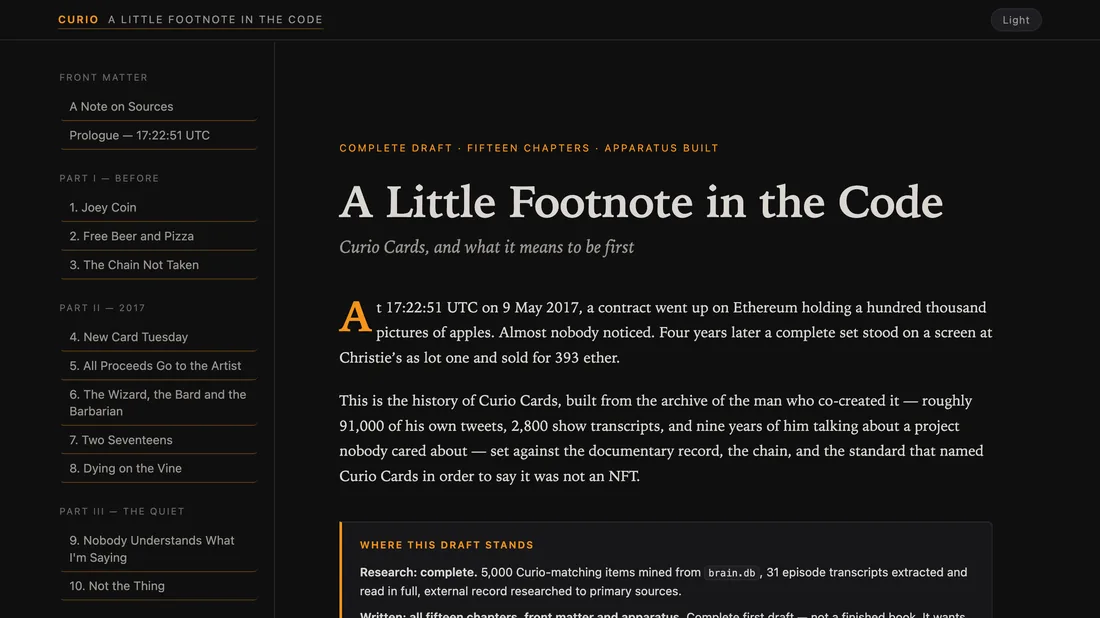
The back half of the month belonged to long-form work. The Curio book was renumbered on the twenty-fourth from sixteen chapters with lettered in-betweens into twenty clean ones, ending on What the Chain Remembers, with its old layout kept in a backup beside it. A second manuscript, a travel memoir called At Least You'll Know My Side, rebuilt itself on the twenty-first with a chronology and, admirably, a page of known gaps; it is not on the roster. On the last morning of the month a local-only Curio market tool assembled itself in under an hour, holders, provenance and sales fetchers with a resumable cursor and a dataset builder, the same morning the book's card notes got a fresh pass. The archive scripts spent the closing days teaching the corpus to recognise Binance and another subject through speech-to-text misspellings, each alias widening backed up before it landed, and WCN hub took Bitcoin Group episode pages 499 through 502. One book tells the story of the cards, one tool counts who held them, and the archive behind both is learning to spell.
The ledger, discounted, and what comes next
Now the haircut. The brain archive moved nearly twenty-five thousand files in October and it is automated ingest. Tidbyt, comics, fillaseat, newszor and daily-thunt ran on their schedules, and the nightly health check filed its report nearly every night of the month, though a person did spend a morning in the Tidbyt folder making welcome screens for house guests and refreshing the midterm countdowns. PageVoice's thirty-seven hundred files are a build output, not thirty-seven hundred decisions. The two virtual model directories took several hundred generated images each, largely one mirrored batch on the twenty-fourth. Private corners, the media index above all, saw heavy work, and this magazine will say nothing more about them. Strip the machines out and October comes down to two games promoted, one reader put on its device, two manuscripts shaped, and four public corrections owned in the log. November's question is whether the adversarial review becomes a standing step for every report, and whether the books, the essays and the songs take the same deliberate walk to the front door that Joshvania and Stackscope took.