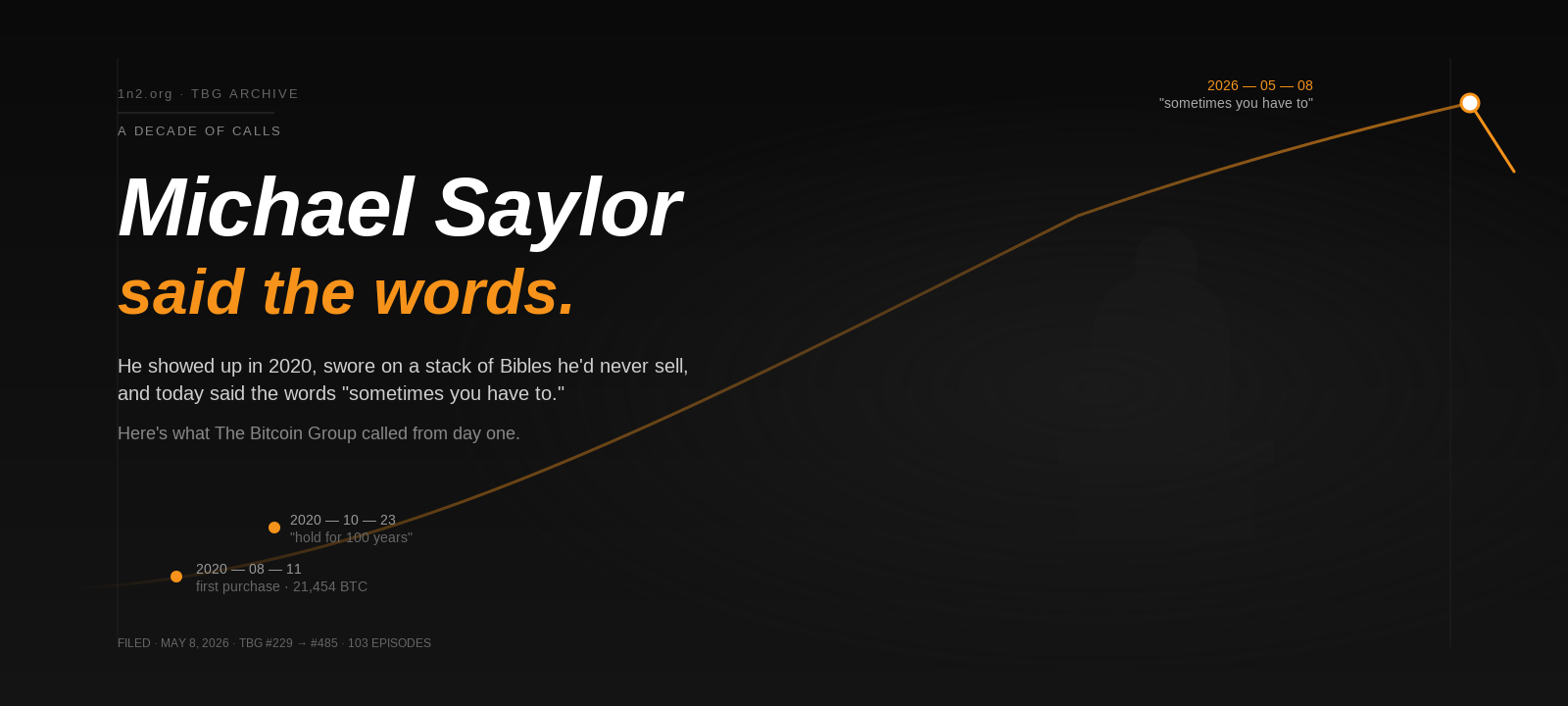
On the May 5, 2026 Q1 earnings call, Michael Saylor — the man who built a personal brand on the words "never sell" — said the company would “probably sell some bitcoin to pay a dividend.” Three days later, in Fortune, he claimed the line was a brushback at short-sellers. Both can be true. What's not in dispute: the doctrine cracked.
For most observers, the reversal arrived in a 24-hour news cycle. For Thomas Hunt's archive of The Bitcoin Group — running weekly since October 2013 — it arrived after 103 episodes of conversation, prediction, skepticism, and adjustment. Saylor first showed up on the show three days after his August 2020 announcement. He never left. The roll call below is what the panel said over those five-and-a-half years, ranked by how early and how clearly each pointed at the pressure. Quotations are taken word for word from the transcript pages in the mirror at 1n2.org/tbg-mirrors: cuts are marked with an ellipsis, misheard words appear as a bracketed best reading, and the notes at the end give the transcript’s own text.
Two things this report is not. It is not a victory lap — Saylor's bet has, to date, returned more dollars to MicroStrategy shareholders than almost any corporate treasury action in history. And it is not a hit piece — the structural fragility the panel kept pointing at is exactly what bit. Document the arc. Let the reader decide.
The arrival, the doctrine, the reversal. Every TBG episode that mentioned Saylor or MicroStrategy lands on the line between them — 103 dots, August 2020 through April 2026.
Eight entries, seven people, ranked by how early and how clearly they pointed at the structural pressure that finally surfaced this week. Thomas Hunt — the host — appears twice: in July 2021 he raised the prospect of Saylor’s board coming to him “with pitch forks”, and in December 2022 he said the tax-loss sale had put the never-sell stance “in question”.
Word for word from the TBG transcript pages, with cuts marked … and misheard words in [brackets], each explained in the notes. Each card links to the canonical mirror at 1n2.org/tbg-mirrors. Two cards carry lines whose speaker the transcript does not establish; they are shown unnamed.
The corporate balance sheet that built the doctrine, the cycles of TBG's attention, and what Saylor's price commentary looked like against the actual price.
The trigger, per the company's own disclosure, was a $12.54 billion Q1 net loss on the back of mark-to-market accounting and a sliding Bitcoin price. The dividend obligation on Strategy's preferred-stock instruments doesn't pay itself. Saylor's framing on the call was real estate: a developer who sells some land at a profit to fund the next round of land buying isn't bearish on land. The market didn't entirely buy it. Three days later, in a Fortune walk-back, Saylor described the remark as a brushback at short-sellers and “haters” — and posted on X urging followers to buy more bitcoin than they sell. Both statements occupy the same five-day window.
What TBG had on tape, as early as episode #269 (July 30, 2021), was the pressure point: a company that had bet its balance sheet on one volatile asset, a quarterly loss, and a board that might one day come to Saylor “with pitch forks”. The dividend mechanism came later, but the math was the same: a company whose entire balance sheet is one volatile asset, with obligations in another currency, eventually meets it. Episode #339 (December 30, 2022) noted that the 704-BTC tax-loss-harvest sale — quietly bought back later — had already softened the spirit of "never sell." Episode #436 (December 28, 2024) mapped the volatility-event scenario almost exactly. None of this was a prediction of doom for Bitcoin. It was a reading of the corporate machine — one that spends fiat to acquire BTC and is required, on a schedule, to spend BTC-equivalent value back to fiat shareholders. That contradiction had a half-life. The half-life ran out this week.
The other thing on tape: Saylor doesn't have to liquidate. He has a treasury, a long history of equity issuance, and a market that — for now — still gives him a premium-to-NAV that funds further accumulation. The likely next move is a small, telegraphed sale staged as a dividend, not a forced unwind. Whether that distinction holds depends on what BTC does next. The doctrine, in its purest form, is gone either way.
The TBG transcripts are machine-made (Whisper) and carry no speaker labels. Where a name, a quotation or an attribution on this page depends on how a word was transcribed, the detail is here. Quotations show a bracketed best reading for a misheard name or word; each note records exactly what the transcript has. Offsets are character positions in the whitespace-normalised transcript text (the transcript body only, without the page header) of the mirror page named.