Eric Trump and the money-printing machine.
A Forbes investigation arrives the day before the Bitcoin Conference; Strategy posts its first positive month since July; and the Celsius founder is, formally, banned from crypto for life.

The Bitcoin Group No. 492 aired with Victoria Jones and Ben Arc at the desk and the host Thomas Hunt reading from the week’s file. The Desk counted 4 discrete topics in the running order, anchored to the operator’s upload.
The opening tease—Do you think Len Sassaman and Hal Finney created Bitcoin?—set the brief.
What follows is a deep-pass debrief: a keyframe per topic, verbatim quotes pulled from the transcript window, attributed by name where the vocative cues in the audio permit it, and a short editorial synthesis in the register the show itself uses. The reference list at the foot of the page is the operator’s own; it has not been refetched or rewritten.
Eric Trump and the money-printing machine.
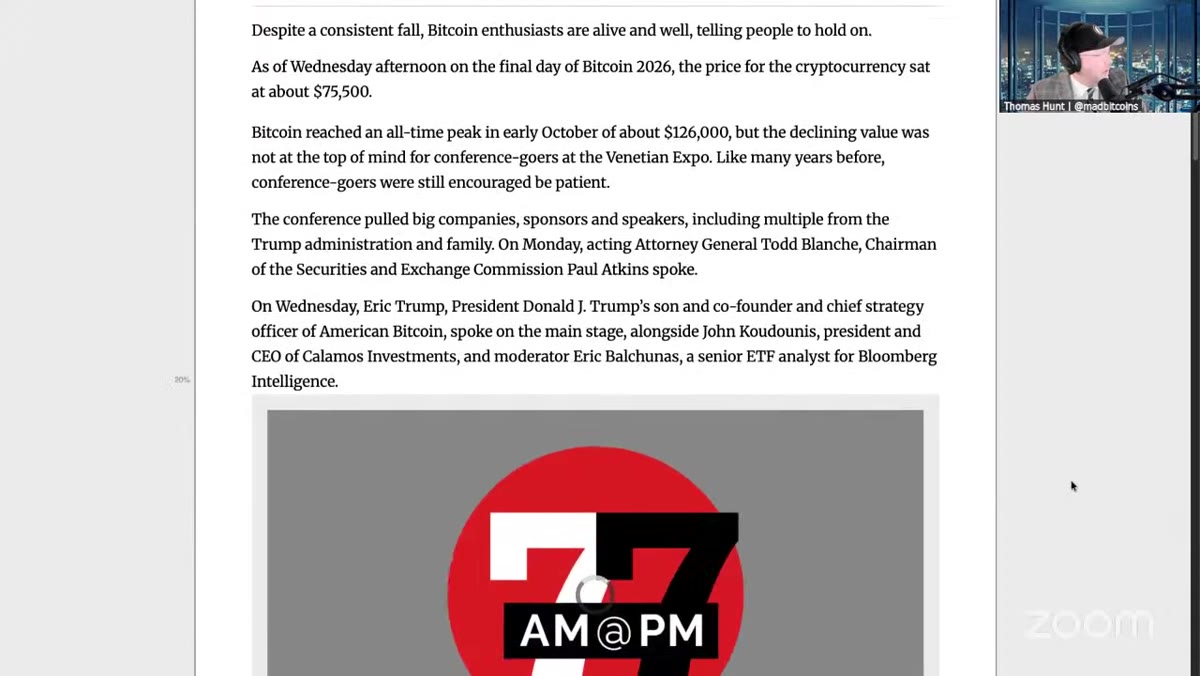
The week opened with a small piece of good news. Bitcoin closed April up 12%, and Strategy — the company formerly named MicroStrategy — posted its first positive month since July, the run that had been the subject of every other episode for the better part of a year. The price stood at $78,180 and a satoshi was worth $1 per 1,279 of them; volume was 1,214 coins changing hands. The panel, on the strength of two consecutive green sessions, allowed itself a measured exhale.
It did not last past the second issue. Forbes had run a long investigation into Eric Trump, the President’s second son, whose Bitcoin company — renamed American Bitcoin after he joined as its third employee — was the subject of the piece. The lede was that the company loses roughly $13,000 on every Bitcoin it mines, but compensates by selling stock at a premium and using the proceeds to buy more Bitcoin. The Forbes framing was a money-printing machine. The panel’s framing was an arbitrage vehicle, dressed in the language of mining.
He’s made about ninety million, I think the funders lost five hundred million for the investors. You kind of hope that your money is safe with the President’s son’s company, I guess.Ben Arc, on the Forbes piece
The host, Thomas Hunt, kept the panel honest on the structural point. Treasury-style operating companies — entities that exist primarily to hold Bitcoin and issue equity against it — have, on the back of Strategy’s example, become a recognized model. Several of them have worked. The Eric Trump vehicle was not, the panel argued, a failure of the model so much as a failure of the version of the model in which the underlying mining operation runs at a structural loss and the equity is sold to retail. The panelist Victoria Jones noted that the article landed twenty-four hours before the Bitcoin Conference; the timing was not commented on by Forbes, and did not need to be.
It looks like an ICL or something, it pumps up and then it just dumps and then it flatlines. And this is what happens to American Bitcoin. So it’s shit-coining in Wall Street.Thomas Hunt · 12:26
Source: source
Celsius, formally
The legal beat belonged to Alex Mashinsky, the founder of Celsius, who, after years of plea negotiation, had accepted an FTC settlement that bans him from the crypto industry for life. The Desk read the operative language verbatim. Mashinsky is, in the words of the order, “permanently restrained and enjoined from advertising, marketing, promoting, offering, or distributing … any product or service that can be used to deposit, exchange, invest, or withdraw assets, whether directly or through an intermediary.” The original FTC judgment had been for $4.7 billion. The settlement number was $10 million. The panel did the arithmetic on screen.
The historical comparison the Desk reached for was Kevin Mitnick, the security researcher banned from the internet in the 1990s and the subject of the “Free Kevin” movement. The point was not exoneration — the panel was clear that Celsius’s collapse had cost depositors badly. The point was that “banned from an industry” is a strange legal artifact, and that the United States has now, twice in three decades, used it on people who built the rails that the next generation will inherit.
Prediction of the week

The episode’s prediction was, characteristically, a domestic one: that the host would, within the year, open a museum of Bitcoin merchandise built around the receipts of the just-completed Las Vegas conference. The panel filed it on the open ledger at /tbg-mirrors/predictions/ for review. There is no over/under yet.
There it is getting free footage from the strip. Then I would walk down the strip, here’s the part two. Las Vegas, what a great place for a Bitcoin convention.Thomas Hunt · 52:04
You got cool Adam Back now, haven’t you? After all the, yeah, he’s, he’s, he’s, he’s under fire at the moment, poor Adam back. You see, Terry got rolled out on Episines Island. But all of a sudden, he looks like someone out of...Ben Arc · 54:49
Drivechains, briefly

A short late segment was given over to a fork project, eCash, which the panel discussed with the impatience reserved for any proposal that copies the Bitcoin subscriber list while disclaiming the Bitcoin name. The Desk’s read, on the second-layer politics around it, was that the proposal is the same proposal, with the same problems, that the show has covered at intervals since 2016. The closing register was tired, not hostile.
As a political move, like somehow Trump’s approval went up off the back of it. I just thought it was that I think it’ll go down in history as one of the most important speeches And hopefully the speech which have ordered like the Third World War, because he could do. Like just the points he made and the way it was delivered.Victoria Jones · 1:50:58
I think it was a very important speech. And hopefully, I hope that it’s gonna turn the tide. Things feel better, it’s sunny, it’s warm, it’s summertime, things feel better. Hopefully there’s gonna be some.Victoria Jones · 1:52:41
Reference Links
Every URL the show linked in its YouTube description, in the order they appeared. The Desk has not refetched these; they are the operator’s own bibliography.
- $77,508 / $1 = 1,290 SAT - Bitcoinal
- Analyst predicts Bitcoin doubling amid Fed's balance sheet expansion - TheStreet Crypto: Bitcoin and cryptocurrency news, advice, analysis and more
- 'Finding Satoshi' Makes the Case for Hal Finney, Len Sassaman as Bitcoin Co-Creators - Decrypt
- Top U.S. Commander Says Bitcoin "Shows Incredible Potential"
- Scammers Target Stranded Ships In Iran With Bitcoin Fees
- Berenberg Tells Investors To Put 45% In Gold, Silver And Bitcoin — Ditches Bonds Entirely | IBTimes UK
- Trump to host bash for crypto investors tied to his coin sales | Donald Trump | The Guardian
- Bitcoin 'Q-Day' Draws Nearer as Quantum Researcher Breaks Simplified Key - Decrypt
- Bitcoin's Quantum Problem Is Really A Governance Crisis In Disguise: UTXO