The strip-club party.
Consensus 2026 holds its flagship afterparty at a Miami club called E11even; four thousand badge-holders are left in the street; the Clarity Act passes; nobody moves.
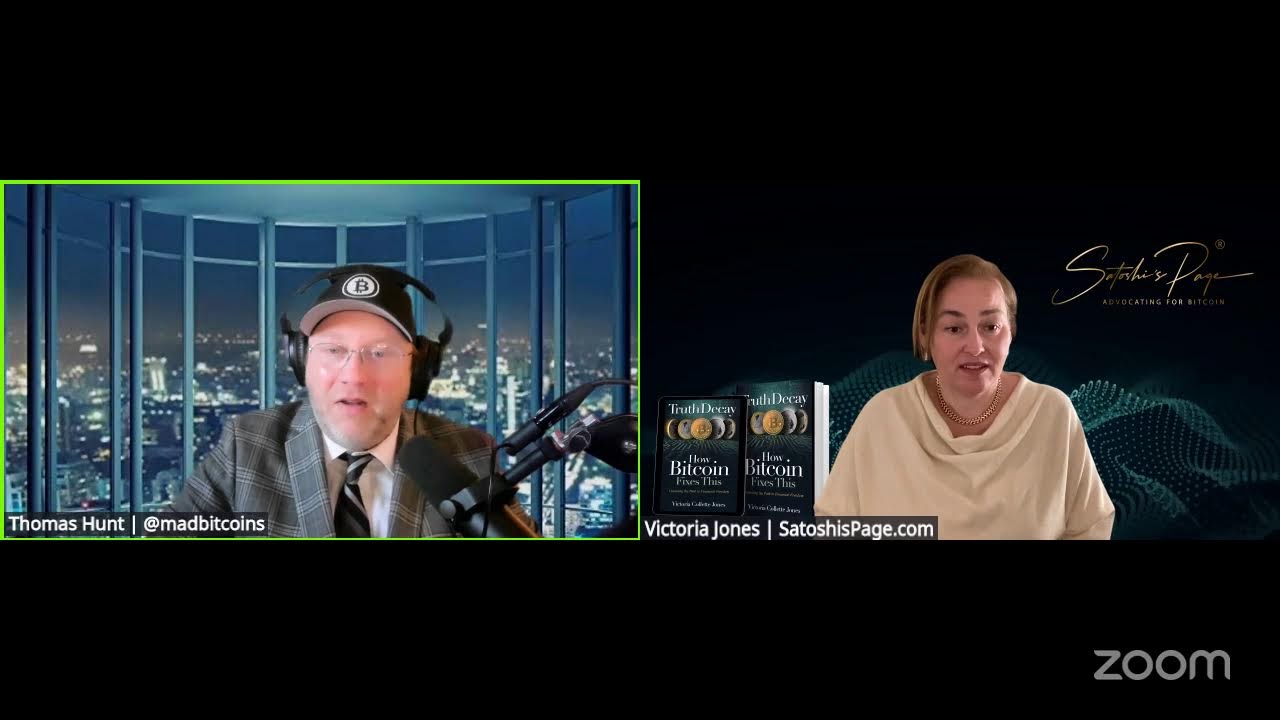
The Bitcoin Group No. 494 aired with Victoria Jones at the desk and the host Thomas Hunt reading from the week’s file. The Desk counted 4 discrete topics in the running order, anchored to the operator’s upload.
The opening tease—Never say never again. Saylor backs down—set the brief.
What follows is a deep-pass debrief: a keyframe per topic, verbatim quotes pulled from the transcript window, attributed by name where the vocative cues in the audio permit it, and a short editorial synthesis in the register the show itself uses. The reference list at the foot of the page is the operator’s own; it has not been refetched or rewritten.
The strip-club party.

Bitcoin closed the week down 2.84%, with a spot of $79,086 and a satoshi worth $1 for 1,264 of them — very close, as the host noted, to the $1,000-satoshi barrier the show has been narrating toward since the spring. The market was the smallest of the week’s stories. The largest, by acclamation, was the Consensus 2026 afterparty.
The official afterparty for the year’s flagship industry conference, organized by CoinDesk, had been booked at a Miami strip club called E11even. The complaint, in the panel’s telling, was not the bachelor-party joke that wrote itself. The complaint was the practical one: the venue holds roughly a thousand people; four to five thousand paying attendees had been issued tickets; and the result was a line of badge-holders, including most of the industry’s women, standing on a Miami sidewalk while the CoinDesk-branded photos were taken inside.
The panelist, the British writer Victoria Jones, had been at the conference and was direct about it.
It wasn’t just inappropriate — it was incredibly low-brow for an industry trying to grow up. I’m all for alcohol, music, a good time, a DJ, a club space — but not at a strip club.Victoria Jones, on Consensus 2026
The host, Thomas Hunt, kept his hands off the moral framing and stayed on the operational one. CoinDesk, he observed, has been the industry’s newspaper of record for a decade; the company is now four owners removed from the one that built that reputation; and the question is no longer whether the brand can survive a bad weekend in Miami, but whether the brand still belongs to people who recognize what it is for.
I think the world needs to grow up really, the fact that these kind of parties even exist that people want to take part or money in that kind of environment. No shade on people who are still in the phase of life where they need to do that, but it certainly wouldn’t be my choice.Thomas Hunt · 10:05
Source: Decrypt
Saylor selling?

The second issue of the night was Michael Saylor, who, on the same week’s earnings call, had spoken openly about MicroStrategy’s capacity to sell. The panel noted the contradiction with his years of public theatre on the subject. Hunt was, to the panel’s surprise, willing to defend him: a public company has a duty to its shareholders; if the math says sell, it sells. The contradiction, in the Desk’s read, was not Saylor’s strategy but his catechism.
I’m not even mad at him for selling, or even thinking about it — I think it’s very reasonable. But this idea that he’s going to just yo-yo and play with everybody, and we’re all just idiots for listening to what he says … kind of seems like we’re idiots for listening to what he says.Thomas Hunt, on Saylor
Source: Yahoo
Clarity Act, with shrug

The Clarity Act — the year’s headline piece of crypto-market-structure legislation — passed in the form the industry had asked for. The price did not move. The panel’s read was that institutions had been selling into the news for a week, and that surging Treasury yields had absorbed any bid the legislation might have generated. The longer point was that the industry has spent a decade arguing that regulatory clarity would unlock a wave of capital; the wave, this week, did not arrive.
The super-cycle number

Somewhere in the closing third, a research note made the rounds predicting a $16 trillion super cycle for Bitcoin. The panel, who have seen these numbers since 2013, were not unkind to the methodology — just bored of the genre. The show has a long memory for forecasts of this size, and it has its own ledger at /tbg-mirrors/predictions/ for them.
The episode closed on a riff about comic books, the source material for a TV show the panel was watching, and what it might mean that the medium with the longest institutional memory for outsider narratives is the one that the streaming services have finally figured out how to monetize. The Desk did not pretend the segue was clean.
As he says here, I was taking pictures of school notebooks and sent them to Claude, trying to get everything to piece together. I also said how I make passwords. I gave Claude context. The user said he recovered five Bitcoin.Victoria Jones · 52:48
Passwords. But at the same time that’s quite dangerous because you’re training the AI as to how a human being comes up with their own password rather than using a computer generated password. So I don’t think there’s you know a a completely foolproof system.Victoria Jones · 54:22
Reference Links
Every URL the show linked in its YouTube description, in the order they appeared. The Desk has not refetched these; they are the operator’s own bibliography.
- Billionaire Michael Saylor said he would never sell bitcoin. After 3 straight quarterly losses, he's changing his mind · Yahoo
- Michael Saylor Backtracks From Sell a Kidney Stance to Selling Bitcoin · Yahoo
- Bitcoin's Biggest Buyer Just Said He Might Sell It. Should You? · Yahoo
- Treasury Secretary Scott Bessent Says the US Is Targeting Iran’s Access to Crypto · Crypto Potato
- Western Union Launches USDPT Stablecoin on Solana via Anchorage Digital · Decrypt
- Samourai Wallet Founder Writes From Prison Asking Bitcoin Community For Help — Family Is Out Of Options · Trading View
- Bitcoin Price Crashes Near Zero on Revolut, Blamed on Third-Party Service Disruption · Decrypt
- Bitcoin Price Surge Incoming? Tom Lee Says 'Crypto Spring' Is Here Amid 2027 'Biggest Rally Ever' Prediction · Yahoo
- Campaigners drop bid to make Swiss National Bank hold bitcoin · Reuters
- San Antonio to post warnings at Bitcoin ATMs after rise in cryptocurrency scams · San Antonio Report
- Caller posing as cop told a Connecticut woman she had a warrant for her arrest — it cost her $14,000 · CT Insider
- Georgia inmate accused of targeting Lindale woman in $13k bitcoin scam · KLTV