Saylor declares spring. The market shrugs.
A familiar pattern from MicroStrategy’s chairman; Cuban quietly trims his bag; and a Republican from Alaska tries, again, to legislate a Strategic Bitcoin Reserve.
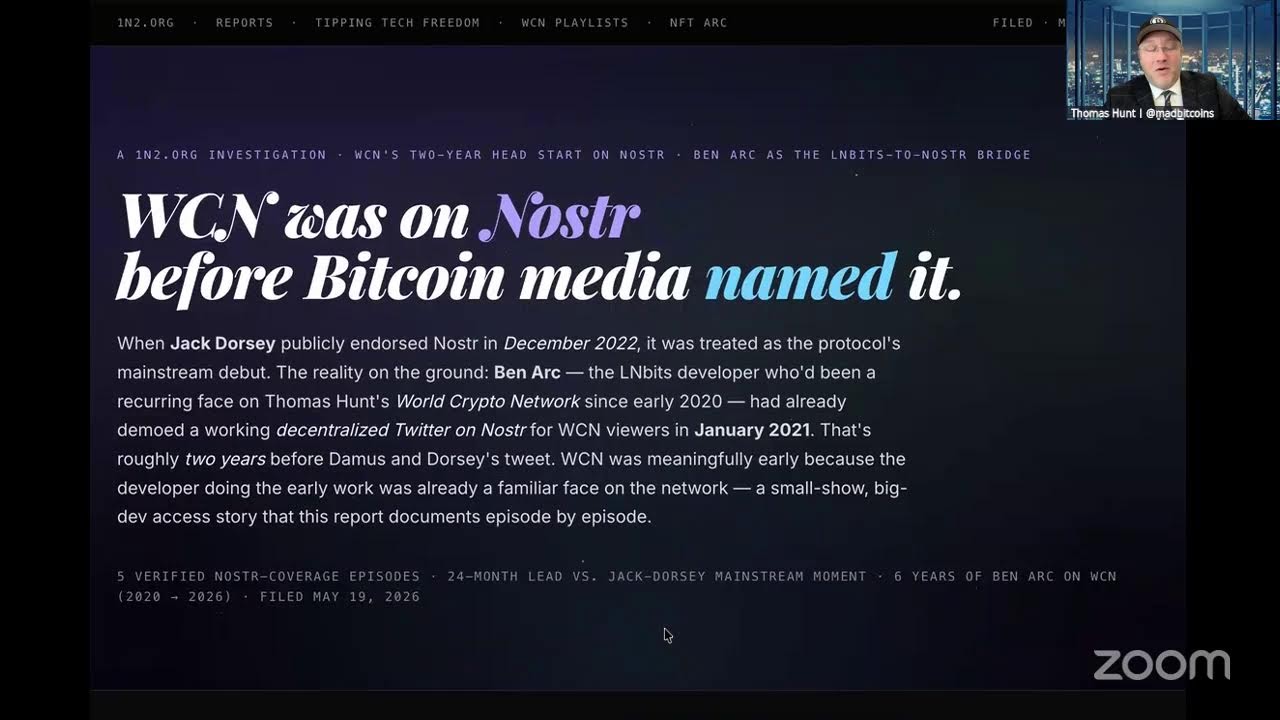
The Bitcoin Group No. 496 aired with Jess C. at the desk and the host Thomas Hunt reading from the week’s file. The Desk counted 4 discrete topics in the running order, anchored to the operator’s upload.
The opening tease—Take a picture with your favorite Bitcoin ATM, cause they’ll be gone soon—set the brief.
What follows is a deep-pass debrief: a keyframe per topic, verbatim quotes pulled from the transcript window, attributed by name where the vocative cues in the audio permit it, and a short editorial synthesis in the register the show itself uses. The reference list at the foot of the page is the operator’s own; it has not been refetched or rewritten.
Saylor declares spring. The market shrugs.

Bitcoin spent the week on the wrong side of a familiar line. With the spot price at $76,256 and a satoshi worth $1 for every 1,315 of them, the panel opened a half hour after the market closed lower for the second straight session. The mood at the desk was less embattled than indignant; on a show that has covered every cycle since 2013, this looked once more like the unhappy middle of one.
The week’s lede was Michael Saylor, who, in another of his regular pronouncements, declared that Bitcoin had bottomed and the market had entered what he called a “spring phase.” The same week, MicroStrategy continued to telegraph more equity issuance, more accumulation, and, in the small print, more selling against complicated stock-market vehicles. The host, Thomas Hunt, asked the panelist, the writer Jess C., to make it make sense.
If Michael Saylor says it, it’s got to be true. I guess he’s a thermodynamic scientist and a mathematician, so he clearly can tell the future. I don’t know what else we expect him to say.Jess C., on Michael Saylor’s “spring” call
The panel returned to a theme that has organized much of the year: the distance between what the largest corporate holder of Bitcoin says in public and what the company actually does. Saylor, they noted, has built a reputation on the maxim that selling Bitcoin is a moral failure; the company, meanwhile, has spent the year selling derivatives, issuing convertible notes, and making structured trades that leave its balance sheet with marginally less Bitcoin after each round. The talk was less about whether the strategy is rational than about whether the rhetoric had stopped tracking it.
I don’t know, I’m always bullish. I’m gonna stick with that, but you know what really matters, what you should base to your future on in all of your life. Choice is is the magic and hard to read eight ball. Here we are. Will the price of Bitcoin be higher this time next week?Thomas Hunt · 6:09
Source: MSN
Cuban quietly sells

The desk turned to a smaller story that lived inside the same theme: Mark Cuban, who had spent much of 2024 explaining his long position on Bitcoin and Ethereum, was reported this week to have trimmed his holdings — quietly enough that the disclosure landed without much of a market reaction. The panel was charitable. Cuban, they observed, has always been clearer than most about treating crypto as an asset class rather than a creed, and a billionaire rebalancing into Treasuries during a soft tape is not, on its face, news. The news was the absence of news: that the trim could be made and disclosed without it being characterized, by Cuban or anyone else, as a betrayal.
Source: Decrypt
An Alaskan tries again
The legislative beat belonged to Representative Nick Begich, Republican of Alaska, who reintroduced a bill to codify a Strategic Bitcoin Reserve at the federal level. The panel walked through the bipartisan co-sponsors and a procedural pathway that, on paper, is no narrower than the one any other reserve-asset bill has navigated — and which, in practice, has stalled in committee in each of the prior two sessions. The Desk’s read was that the language has tightened with each iteration, even as the political weather around it has not improved.
You know, the real problem with business is all the people. And Ben, I think you’re muted or you’re mic stopped working.Jess C. · 47:50
ATM spiral, AI bubble

A long middle section was given over to the country’s Bitcoin ATM network, where the panel argued that the model is now consuming itself: high fees, narrower margins, regulator pressure, and a wave of consumer-protection lawsuits that has moved from local district courts into state-level actions. The hosts were not mourning the operators. They were noting, as the show has done before, that ATMs were always a transitional rail, and that the rail is now being torn up faster than its replacements have been laid down.
The episode closed in an unusual register, with an extended exchange about an AI bubble that the panel was, for the first time, willing to describe in those terms. The argument was less about valuations than about timing: that the labor displacement, particularly among junior software developers in emerging markets, was running ahead of any plausible answer to it.
This is why we kind of need an AI bubble — so we can have some time just to take the foot off the accelerator and actually think about how we’re going to solve some of these problems.Jess C., on the labor question
The show signed off, as it has for thirteen years, with a book recommendation and a wave to the audience. The recommendation, this week, was a science-fiction novel about memes that the panelist could not remember acquiring. The Desk did not press the point.
It’s a lot of these tech workers, particularly doing junior roles in development. You know, like you’re hiring them from India or I don’t know, like some developing economy where you can get cheap labor over the internet and that as an industry is really being throttled now for people and that’s a shame. That’s a real shame.Jess C. · 50:55
I think they could get there. I think a couple thousand dollars, who come to the set, like he’s available. His father doesn’t want to go to his wedding, but other than that, they could get him.Jess C. · 1:23:51
Source: Decrypt
Reference Links
Every URL the show linked in its YouTube description, in the order they appeared. The Desk has not refetched these; they are the operator’s own bibliography.
- Michael Saylor says Bitcoin has bottomed, calls market a ‘spring’ phase · MSN
- Mark Cuban Says He Sold Most of His Bitcoin · Decrypt
- U.S. Lawmaker Unveils Bill to Codify Strategic Bitcoin Reserve, Draws Bipartisan Support · MSN
- SpaceX is sitting on a massive hoard of bitcoin · Business Insider
- Billionaire Novogratz Fights $100 Million Fee on Dud Crypto Deal · Bloomberg
- Bitcoin Depot Goes Bankrupt, Signaling Demise of Crypto ATMs · Bloomberg
- Retired Covina couple speaks out after being scammed out of $845,000, losing their life savings · ABC 7
- Bitcoin ATM Firm CoinFlip Blasts 'Meritless' Lawsuit as Missouri Demands Restitution for Seniors · Decrypt
- Tech Workers, Long Treated Like Aristocracy, Are Now Human Waste · Futurism
- https://bitcoinmagazine.com/news/us-bill-codify-strategic-bitcoin-reserve