Venezuela as Bitcoin's case study: 'The world has changed'
August 24, 2017. CNBC publishes "Bitcoin mining is popular in Venezuela because of hyperinflation." Within minutes, @MadBitcoins quote-tweets it with three words and two hashtags. The tweet hits 714 favs and 350 retweets — the single highest-engagement original post of the entire 2017-2018 peak influence era.
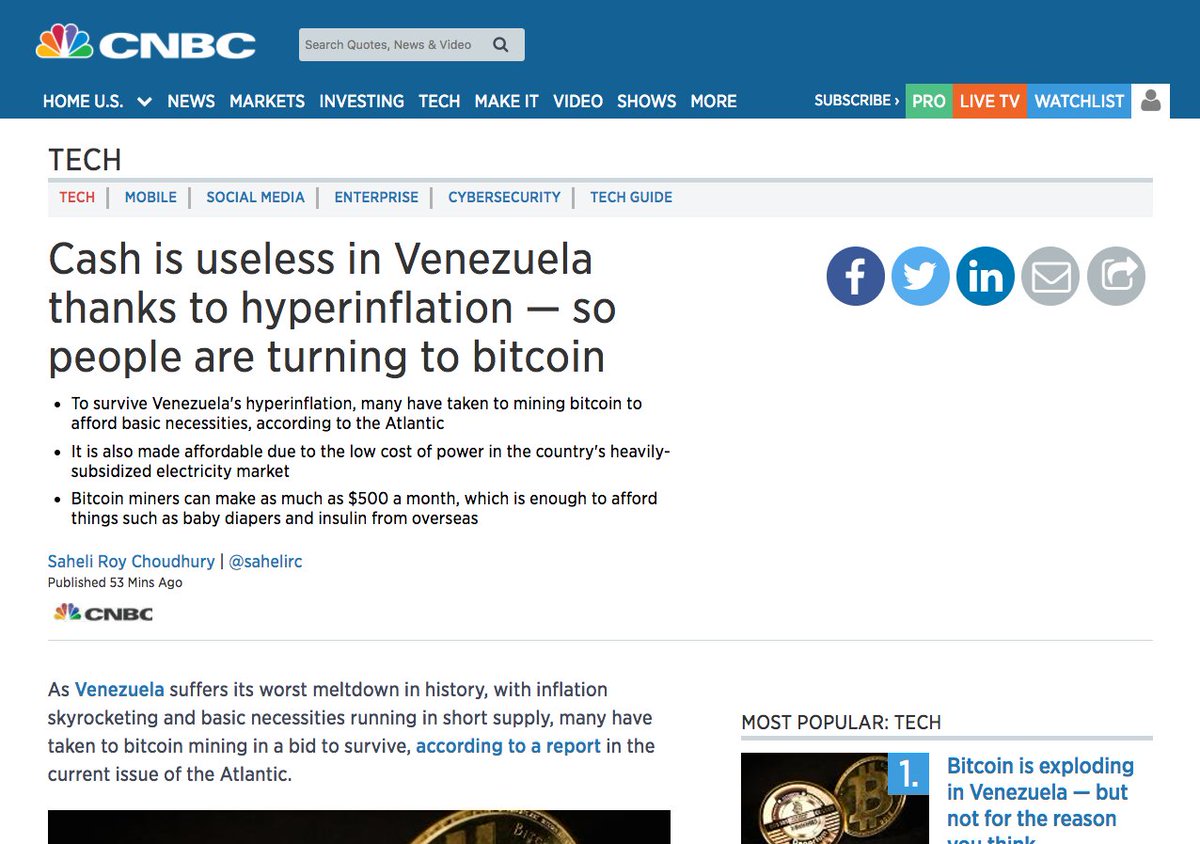
It isn't reporting news. It's stating a thesis. The thesis is that Bitcoin has crossed from "speculative store of value" to "a tool people in actual hyperinflation are actually using." The CNBC piece does the documentation. Hunt does the framing. The audience does the rest.
The Venezuelan context
Venezuela's inflation crisis was, by August 2017, well into its catastrophic phase. The IMF would later estimate 2017 inflation at 438%; by 2018, it would hit 65,000%. The bolívar fuerte had become functionally worthless for cross-border transactions. The Maduro government had tightened currency controls. Ordinary Venezuelans were facing both hyperinflation and the inability to legally convert what little bolívar value they had into hard currency.
Bitcoin in this environment wasn't an investment thesis — it was a survival tool. Venezuelans began mining Bitcoin in significant numbers because electricity was state-subsidized to the point of being effectively free, while the dollar value of mining rewards remained denominated in actual dollars. The CNBC piece reported on a Venezuelan miner whose monthly earnings, in dollar terms, were a multiple of any wage available to him in bolívares. Bitcoin had stopped being theoretical.
Why Hunt's framing landed
"The world has changed" is, on its surface, a generic line. What makes it work is the timing and the context. By August 2017, Bitcoin had been around long enough that the original libertarian arguments — Bitcoin as escape from monetary policy, Bitcoin as bearer asset for the unbanked — had become familiar. They were the white-paper arguments. They were the talking points. What was unfamiliar was an actual case where those arguments stopped being theoretical and became operational.
Venezuela was that case. The CNBC piece was the trade-press validation that the case was real. Hunt's three-word framing converted the news into a generational claim: not "Venezuelans use Bitcoin," but "the world has changed." The framing collapsed the time horizon. The Bitcoin thesis wasn't a future bet anymore; it was a present-tense fact.
The 714/350 numbers
The engagement is worth dwelling on. The era median for an original @MadBitcoins tweet was, by 2017, in the 5-15 fav range. Cracking 100 was rare. Cracking 700 happened once in the era — on this tweet. The fav-to-RT ratio of roughly 2:1 is the signature of a tweet that the audience both endorsed and shared. People weren't only nodding; they were forwarding the framing onward.
The Venezuela tweet became, in the years afterward, the most-cited @MadBitcoins tweet when external writers wanted to date the moment Bitcoin's narrative shifted. It is, structurally, why "Bitcoin as Venezuela hyperinflation hedge" became a default talking point for the rest of the cycle. The tweet didn't create the use case. It named the moment when the use case became publicly acknowledged.
"The world has changed" is also a tweet Hunt would never need to update. The framing held in 2018, when Venezuela launched its own state cryptocurrency (the failed Petro). It held in 2019-2020, as more hyperinflation case studies emerged (Argentina, Lebanon, Zimbabwe). It held in 2021, when El Salvador adopted Bitcoin as legal tender. Each of those events was downstream of the framing the August 24, 2017 tweet locked in.
This article is part of a deep-dive series on the @MadBitcoins Twitter archive — 91,295 tweets across 13 years. See all articles → or read the Curio + WCN Co-Host era overview.