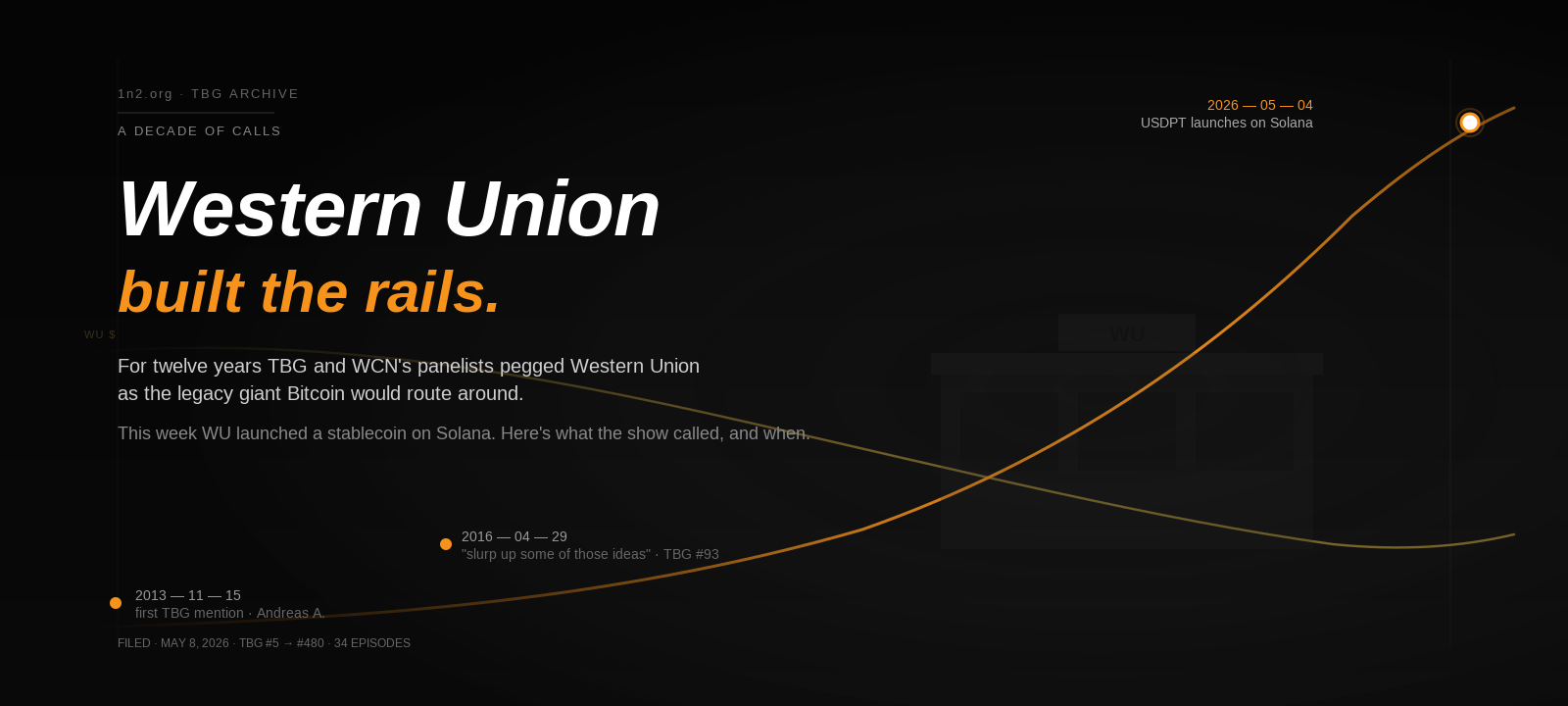
On May 4, 2026, Western Union — the textbook 1851-era remittance giant that crypto was supposed to bury — announced that it was launching a U.S.-dollar stablecoin called USDPT on Solana, issued by Anchorage Digital and run on Fireblocks. For twelve years, panelists on Thomas Hunt's Bitcoin Group pegged Western Union as the most obvious legacy-finance loser in a Bitcoin world. They were half right. The fees were unsustainable. The dinosaur didn't die. It evolved.
The roll call below is what the show actually said, sorted by who saw the pivot coming — not just the disruption. Saying Western Union is doomed is one prediction. Saying Western Union will slurp up the new tech and absorb it is a much harder, much rarer prediction. That second one is what TBG had on tape as early as episode #93, in April 2016. The 34 TBG episodes mentioning Western Union span from November 15, 2013 through January 31, 2026. The quotations here are word for word from the episode transcripts, cuts marked with an ellipsis, with episode links into the canonical mirror at 1n2.org/tbg-mirrors.1
Two things this report is not. It is not a victory lap — being right that legacy-remittance fees were unsustainable was, in 2013, the median Bitcoin opinion. And it is not a hit piece — Western Union's pivot is, on its own terms, a serious move. The company chose Solana, which is what it sounded like the show eventually wanted them to choose: cheap settlement, agent-side liquidity, regulated issuance. The point of the document is the gap between the easy call (death) and the hard one (absorption). Most of TBG was on the easy call. A few panelists were on the hard one.
The first call, the pivot prediction, the pivot itself. Every TBG episode that mentioned Western Union sits on the line between them — 34 dots, November 2013 through January 2026.
Eight panelists, ranked by how clearly they pointed at the move Western Union actually made. The most prescient calls aren't that Western Union will die — that was the consensus take. The most prescient calls are that Western Union won't die, and will co-opt the tech and build it itself. Paul Puyi said it ten years out. Jimmy Song said it five months out. Thomas wrote the open letter halfway in between.
Word for word from the TBG transcripts, cuts marked with an ellipsis. Each card links to the canonical mirror at 1n2.org/tbg-mirrors.
Western Union stock vs. Bitcoin, log-scaled. TBG's twelve-year cycle of attention. Fees, side by side. The scoreboard for the shape of the bet.
USDPT is built on Solana, issued by Anchorage Digital Bank N.A. — the only federally regulated crypto bank in the United States — and runs on the Fireblocks infrastructure that already secures more than $14 trillion in digital-asset transactions. Initial rollout is treasury-and-agent settlement, starting in the Philippines and Bolivia. A consumer-facing wallet branded "Stable by Western Union" is targeted for 40+ countries through 2026. The headline mechanic — internal liquidity and agent settlement on a public blockchain — is exactly the architecture Thomas described in TBG #275 (September 2021), except WU chose Solana instead of Lightning.
What TBG had on tape, as early as episode #93 (April 29, 2016), was the corporate logic. Paul Puyi said the line in plain English: "…it's actually Western Union that's going to slurp up some of those ideas and projects and just incorporate them into their business portfolio." Tone Vays,3 in the same episode, sketched the kiosk-and-rails model. Then five months ago, in episode #476 (December 27, 2025), Jimmy Song called the entire stablecoin category "Western Union 2.0." Western Union's actual pivot is, almost literally, a stablecoin. The framing turned out to be the product.
The Western-Union-is-dead call — Andreas in 2013, Dan Eve in 2019, the Blockbuster comparison repeated across half a dozen episodes — was always partly right and partly wrong. WU's stock did fall from a 2019 high of $26.79 to $8.46 in April 2026. The remittance margins did get squeezed. The fees did become indefensible. But the company didn't fold. It bought time, found a chain, and signed an issuer. Tip the hat to Paul Puyi, who called it in 2016. Tip it to Jimmy Song, who reframed the whole stablecoin space as "Western Union 2.0" in December and watched WU make the framing literal four months later. And tip it to Thomas Hunt, who wrote the playbook in TBG #275: keep the storefronts, swap the rails. That's the move. Document the arc. Let the reader decide what the next decade looks like.
/wcn-hub/tbg-mirrors/transcripts/TBG-NNN.html (offset = character position in that page’s transcript text, whitespace collapsed): TBG-005.html:20216 (Andreas Antonopoulos); TBG-008.html:39196 (closing line); TBG-010.html:12253; TBG-093.html:61403 (Paul Puyi) and :63197 (Tone Vays); TBG-193.html:17857 (Thomas Hunt) and :18568 (Dan Eve); TBG-264.html:42735; TBG-275.html:15203; TBG-278.html:12314; TBG-370.html:28500 (Thomas Hunt) and :28760 (Victoria Jones); TBG-476.html:7245 (Jimmy Song). The transcripts are machine-generated, with no speaker labels and loose punctuation. Punctuation inside the quotations follows the file; every cut, including a cut at the start or end of a sentence, is marked “…”; no fillers have been dropped. Panelists are identified by the host’s name hand-off, and the host’s own lines by turn structure (he opens the issue or hands off to a named panelist straight after), except where a note below says otherwise. The same passages are quoted in the timeline cards and the closing section. The USDPT statement is Devin McGranahan’s, quoted as carried in Decrypt’s report (checked 17 Nov 2026), which also gives the product name “Stable by Western Union”. Corrected 17 Nov 2026: several cards had small wording differences from the transcripts (“convert” for “converted”, “percentages” for “percentage”, “a Western Union office” for “a Western Union or offices”, a dropped “and”, added commas) or unmarked cuts; they now match the files. ↩