The Mad Factory
The Mad Factory
The studio Thomas Hunt formalized in September 2025 to publish work — eight years after he co-created Curio Cards.
There is a moment in any artist's career when the practice has to formalize. The notebook becomes a portfolio. The portfolio becomes a studio. The studio gets a name, and the name gets a wallet address. For Thomas Hunt, that moment arrived in September 2025 with the founding of Mad Factory.
The OpenSea profile is unsentimental about it.  mad factory avatar"Mad Factory NFTs is a collection of unique digital artworks created by Thomas Hunt (Curio Cards)." Joined Sep 2025. Wallet 0x5fd2…8c73. That is the entire bio. The man who co-created the first art-NFT project on Ethereum in May 2017 — the project Christie's later sold at auction for 393 ETH — has returned to the medium under a new name, presented in the flattest possible terms, with nothing to prove and nothing to hide.
The name itself is a continuity. Thomas's broadcast persona, Mad Bitcoins, was named in 2013, deep in the first cycle. The studio he ran in the YouTube years eventually consolidated into the umbrella under which his various projects — the daily show, the conference coverage, the MidJourney experiments — were organized. Mad Factory is what the visual production arm becomes when it is formally separated out: a name that announces "this is now a place where work is made, on a schedule, with intent."
The collections inside it, as visible on the OpenSea Created tab as of May 2026 (seven distinct collections, roughly seventy-seven minted pieces in total):
- CURIOxMIDJOURNEY — 30 items, 0.10 ETH total volume. The bridge piece. Discussed in its own essay alongside this one.
- Mad Rabbitz — 12 items.
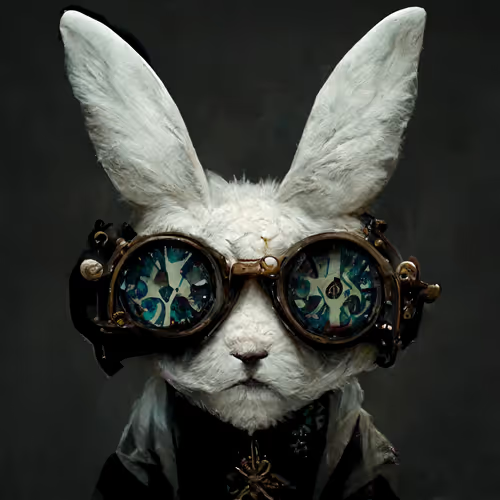 mad rabbitzA character cycle continuous with the white-rabbit motif that runs through the MadArt MidJourney archive's Down the Rabbit Hole set.
 - Curio Samurai — 12 items.
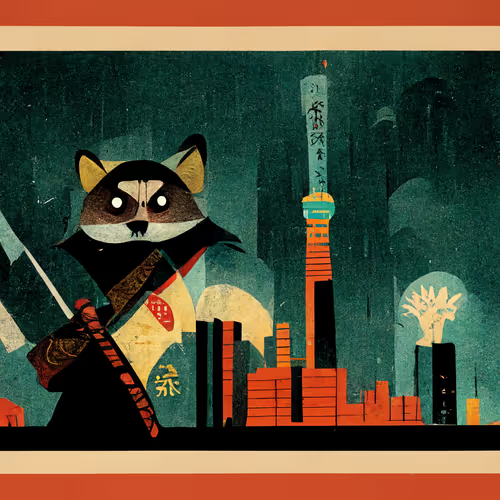 curio samuraiSamurai iconography given the Curio Cards posture — small editions, single subject, deliberately quiet against the maximalist tendencies of default MidJourney output.
 - Raccoon Breakfast — 7 items.
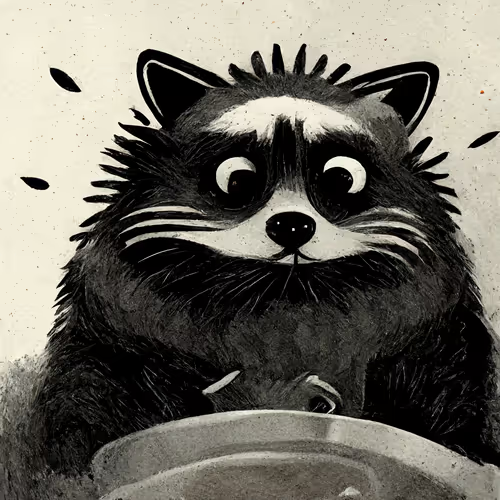 raccoon breakfastOne of four separate Raccoon collections.
 - Raccoon Moon — 7 items.
- Laser-Eyed Raccoons — 6 items.
- Cypherpunk Raccons — 3 items (sic, the spelling is the artist's).
The volume figures are modest by NFT-bull standards — fractions of an ETH per collection, total volume across the studio currently around 0.30 ETH, roughly $600 at today's prices — but the volume figures are not really the story. None of these collections is priced as a speculation. They are priced as art objects from a working studio: a few hundred dollars apiece for editions of three to thirty.
What is striking is the distribution of motifs. The Raccoon — the figure that runs through the MadArt MidJourney archive in cycles of hundreds (the Raccoon Bestiary essay traces it in detail) — gets four separate NFT collections of its own: Breakfast, Moon, Laser-Eyed, Cypherpunk. The MadArt body and the Mad Factory body share an iconography. The same characters move between the two. This is what it looks like when a non-NFT practice (9,481 MidJourney images, August 2022 through March 2025) and an NFT practice (77 minted pieces, beginning September 2025) are run by the same person from the same visual library.
The CURIOxMIDJOURNEY collection is the specific bridge between the two halves. It is the only Mad Factory drop that explicitly cites the 2017 Curio Cards aesthetic. The other six collections are continuations of the MidJourney exploration; CURIOxMIDJOURNEY is the one where the legacy line crosses.
There is a question worth pausing on: what does it mean to launch a new NFT project in 2025–2026? The market context is not the 2021 bull. The 2024 cycle was driven by ETFs and BTC price, not by new art primitives. JPEGs are no longer the front page. Christie's no longer runs all-ETH auctions as headline events. The audience for new NFT art has shrunk to people who actually care about specific artists rather than people who think the next mint will moon. To launch a studio into that market — to mint anyway, to price modestly, to keep going — is a statement about why the work is being made. It is not being made because the market wants it. It is being made because the artist intends to ship.
This is, arguably, the healthiest moment in NFT history for an artist to formalize. The speculators are gone. The collectors who remain are the ones who collect because they collect. Thomas, who watched the medium be born in 2017 and watched it inflate and deflate twice over, is now releasing work into the version of the market that most resembles a normal art market: small editions, no hype, the artist keeping the practice going because that is what artists do.
The MadArt archive — 9,481 MidJourney images, parallel to but distinct from Mad Factory — is the unsold body. Mad Factory is the published one. Together they map a single visual practice across two registers: the daily generation and the formal release. Mad Factory is not the artist's output. It is the artist's publication.