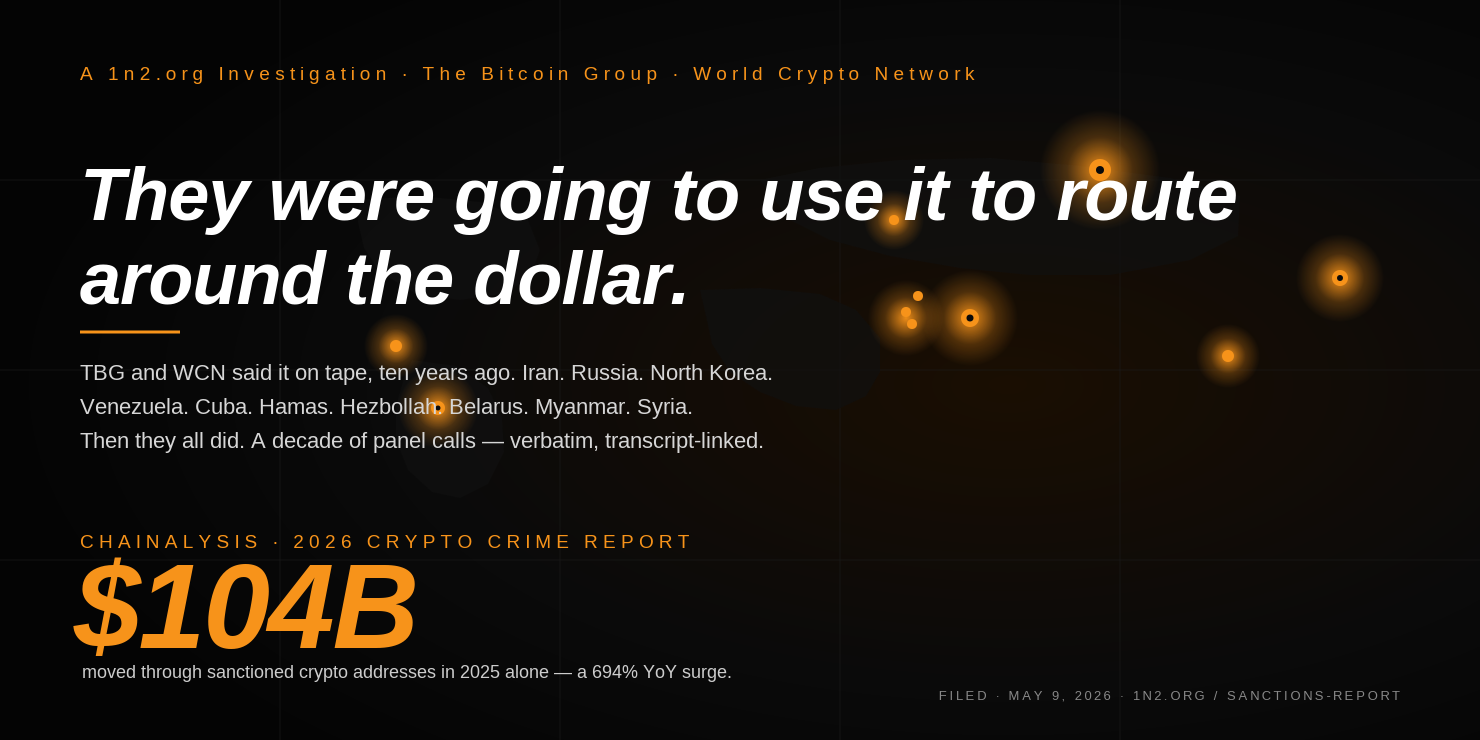
TBG was calling this by 2017. Iran, Russia, North Korea, Venezuela, Cuba, Hamas, Hezbollah, Belarus, Myanmar, and Syria have all since used Bitcoin or stablecoins to route around US/EU sanctions. Here's the panel's running record — country by country, episode by episode.
The conventional financial press came around to "crypto and sanctions" as a serious story sometime around February 24, 2022 — the morning of Russia's full-scale invasion of Ukraine. The Bitcoin Group and the broader World Crypto Network archive — running weekly since October 2013 — had been on the topic for years before that. Iran's dollar exposure showed up on the show as early as TBG #188 (September 7, 2018). North Korea was already a regular issue by TBG #146 (June 16, 2017). Venezuela's Petro was being handicapped on-air the same year it was being announced. The point of this report is the timeline: panelist call, then real-world event, country by country, with transcript link on one side and Treasury or court filing on the other.
Two things this report is not. It is not a victory lap — the panel got plenty wrong, and the panel that called Bitcoin's role in sanctions evasion correctly is also the panel that has consistently liked that property of the asset. It is not a cheerleading exercise either. The closing section flags the obvious counterweight: the volumes evading sanctions through crypto, even at 2025's eye-watering $104B, are still small compared to the trade-misinvoicing, hawala, and shell-company channels traditional finance has run for half a century. Document the calls. Document the events. Let the reader weigh the gap.
For each highlighted country: the earliest TBG/WCN episode that flagged it as a sanctions-evasion vector, paired with the earliest verified real-world event — Treasury OFAC action, court filing, primary news report. Click a country to scroll to its dossier.
Panelists ranked by who pointed at the sanctions-evasion mechanism earliest and most clearly. Quotes are given word for word from a named transcript file, with every edit marked.15
Quoted from the TBG transcripts; brackets and ellipses mark every edit. Each card links to the canonical mirror at /tbg-mirrors.
Sanctions-evasion events by year, the $104B Chainalysis number in context, TBG's own attention cycles, and the country-by-country mention heatmap of who the panel watched first.
The story Western financial-press desks finally caught up to in 2022 was, on this archive, a story The Bitcoin Group had been working since the Obama-era second term. Episode #188 (September 7, 2018) named the dollar-denominated commodity-export channel as the load-bearing wall of the sanctions regime. Episode #213 (March 6, 2020) identified Iran as the canonical case two and a half years before Iranian state policy formally legalized crypto-funded imports. Episode #298 (March 4, 2022) framed the Russia question with a clarity the BIS would not match for another six months: Bitcoin can collect Ukrainian donations and route Russian sanctions evasion. Same network, opposite directions, neutral protocol. None of those calls were a prediction of the dollar's death — they were a reading of where the dollar's enforcement edge was thinnest.
The honest counter is that the volumes are still small. Chainalysis's headline $104B in 2025 sanctioned-address flow is real and it is a 694% surge — but it sits next to a traditional-finance sanctions-evasion machine that runs on trade misinvoicing, shell companies, and dollar-cash hawala routes that have moved hundreds of billions per year for decades. Crypto became a meaningful evasion rail; it has not become the rail. The panel's call is that the gap is closing, not closed. That, too, is on tape: TBG #476 (December 27, 2025) — Jimmy Song describing stablecoins as "Western Union 2.0" and sending Tether back and forth to Russia as "a very common use case."18 Document the arc. Let the reader decide whether the next ten years extend the trend or break it.
TBG-188.html@35256). The transcript has “sold oil and anything other than USD”; [in] is the best reading. The transcript has no speaker labels and the panel was two people, Andy Hoffman and Thomas Hunt. The turn is credited to Hunt because it answers Hoffman's “it's a non-story” (“I'm not sure it's a non-story”, @34857) and refers back to his mention of Iraq (“like you mentioned”). This is an inference from the turn structure, not an identification. ↩TBG-213.html@42409). The transcript has “The correct answer is there are a public of Iran, Iran, that's right.” The words in brackets are the best reading. The speaker is the host, Thomas Hunt, giving the answer to his own exit question after reading out the guesses in the chat (@42288). ↩TBG-109.html@64776). The transcript has “Swift alternatively”; [alternatives] is the best reading. The speaker is not established: the line is a question put in the middle of another panelist's answer, the transcript has no speaker labels, and the panel was Ian DeMartino, Tone Vays and Thomas Hunt. Earlier versions of this page credited it to “Thomas Hunt panel”. ↩TBG-297.html@11945). Earlier versions credited this to Thomas Hunt. It is Dan Eve's: it falls inside the answer that follows Hunt's hand-off “Dan, Eve, your thoughts on the general situation in Ukraine” (@8651), before Hunt next speaks. ↩TBG-188.html@36681 and @37427). Earlier versions credited the Venezuela and North Korea lines to Thomas Hunt. The transcript has no speaker labels; the panel was Andy Hoffman and Hunt. The lines are credited to Hoffman as an inference, not an identification: they open the answer to the exit question (@36583), which on this episode Hoffman answers first and Hunt second, as at the episode's other exit questions, and the speaker says “I still believe that Japan has the most to gain”, picking up the Japan argument made earlier in what reads as Hoffman's turn. ↩TBG-145.html@68520). The transcript has “Jim Kramer”; the reading is Jim Cramer. Speaker: Jimmy Song, answering Hunt's “Jimmy Song, prediction or story of the week.” Earlier versions ended this quotation with “Bitcoin is growing up”, which is not in the transcript. ↩TBG-229.html@669). The transcript has “Al-Qasim Brigades”; the reading is al-Qassam Brigades. The full stop after “three” is the transcript's. The speaker is Hunt, reading the issue before handing to Ben Arc. ↩TBG-261.html@29896). Earlier versions credited this to Thomas Hunt. It is Josh Scigala's: it is part of his answer to Hunt's question that begins “Josh Shagalla, even though report after report shows that Bitcoin does not fund terrorism” (@29242; transcript spelling). ↩TBG-459.html@11891). Earlier versions said “Thomas Hunt panel”. The transcript has no speaker labels; the speaker is taken to be Hunt because the turn answers a panelist's “But Thomas, you're” (@11177) and is addressed to Josh (“I was saying to Josh”) on a three-person panel of Ben Arc, Josh Scigala and Hunt. This is an inference, not an identification. ↩TBG-297.html@3929). The transcript has “where it is China go”; [does] is the best reading. The speaker is Hunt, in the turn he addresses to Josh Scigala (“I think one of the reasons this is so jarring to everyone, Josh”). Earlier versions used, for Belarus, a line from the episode's opening issue that does not mention Belarus, and said Belarus was named in the title segment. It is not. ↩TBG-298.html@45584). Earlier versions credited this to Dan Eve. It is Thomas Hunt's: the turn ends with Hunt's hand-off “Dan, Eve, your thoughts about China cracking down on Bitcoin?” (@45786). Hunt uses the same Invention of Lying comparison again in TBG #479 (“again I just sound like I'm quoting the invention of lying”, @57215). Dan Eve's place in the roll call therefore goes to Hunt. ↩TBG-238.html@37819). The transcript has “in the mountains of Myanmar is a consent and buy an MP3”. The words cannot be read with confidence and are shown as [unclear]. Earlier versions inserted “[pleb]” there and credited the line to Thomas Hunt. The transcript has no speaker labels. The passage falls in the long turn that follows Hunt's hand-off to Josh Scigala (“so Josh Kigala”, @33426), broken only by a remark about the stream's thumbs-down count, and the speaker describes holding Ripple at its launch. It is credited to Scigala as an inference, not an identification. ↩TBG-310.html@42627) the transcript has “Valtoro”; [Vaultoro] is the reading. The speaker is identified by Hunt's “Go ahead, Joshua.” (@42586). ↩/wcn-hub/tbg-mirrors/transcripts/TBG-NNN.html. Offsets count characters in that file's transcript text, with paragraphs joined by single spaces and HTML entities decoded, and point at the first quoted word. Square brackets are best readings of misheard words, each explained in its own note; … marks every omission, including dropped repetitions; the transcript's own punctuation is kept. The transcripts have no speaker labels, so speakers are identified from the host's hand-offs; where that leaves room for doubt the note says so. This revision (17 November 2026) re-checked all of them. Earlier versions said every quote was verbatim; most had been tidied, shortened without ellipses or rearranged, seven were credited to the wrong speaker and four to a vague one (“TBG panel”, “Thomas Hunt panel”). The table lists each quotation and its source.| Where on the page | Speaker | Source |
|---|---|---|
| dossier iran.tbg_first | Thomas Hunt | TBG-188.html@35256 |
| dossier iran.tbg_canonical | Thomas Hunt | TBG-213.html@42409 |
| dossier russia.tbg_first | Unidentified panelist | TBG-109.html@64776 |
| dossier russia.tbg_canonical | Dan Eve (Crypto Raptor) | TBG-297.html@11945 |
| dossier russia.alt_canonical | Thomas Hunt | TBG-298.html@45584 |
| dossier north_korea.tbg_first | Jimmy Song | TBG-146.html@47386 |
| dossier north_korea.tbg_canonical | Andy Hoffman | TBG-188.html@37427 |
| dossier venezuela.tbg_first | Thomas Hunt | TBG-158.html@42400 |
| dossier venezuela.tbg_canonical | Andy Hoffman | TBG-188.html@36681 |
| dossier cuba.tbg_first | Jimmy Song | TBG-145.html@68520 |
| dossier cuba.tbg_canonical | Thomas Hunt | TBG-273.html@32648 |
| dossier hamas.tbg_first | Thomas Hunt | TBG-209.html@12082 |
| dossier hamas.tbg_canonical | Thomas Hunt | TBG-229.html@669 |
| dossier hezbollah.tbg_first | Josh Scigala | TBG-261.html@29896 |
| dossier hezbollah.tbg_canonical | Thomas Hunt | TBG-459.html@11891 |
| dossier belarus.tbg_first | Thomas Hunt | TBG-297.html@3929 |
| dossier belarus.tbg_canonical | Thomas Hunt | TBG-298.html@45584 |
| dossier myanmar.tbg_first | Josh Scigala | TBG-238.html@37819 |
| dossier syria.tbg_first | Josh Scigala | TBG-261.html@29896 |
| dossier syria.tbg_canonical | Josh Scigala (Vaultoro) | TBG-310.html@42627 |
| roll call #1 | Thomas Hunt | TBG-188.html@35256 |
| roll call #2 | Thomas Hunt | TBG-213.html@42409 |
| roll call #3 | Andy Hoffman | TBG-188.html@37427 |
| roll call #4 | Jimmy Song | TBG-146.html@47386 |
| roll call #5 | Thomas Hunt | TBG-298.html@45584 |
| roll call #6 | Josh Scigala | TBG-310.html@42627 |
| roll call #7 | Wassim Alsindi | TBG-449.html@40877 |
| roll call #8 | Victoria Jones | TBG-484.html@23538 |
| quote wall 1 | Thomas Hunt | TBG-213.html@42409 |
| quote wall 2 | Thomas Hunt | TBG-188.html@35279 |
| quote wall 3 | Andy Hoffman | TBG-188.html@37483 |
| quote wall 4 | Thomas Hunt | TBG-298.html@45584 |
| quote wall 5 | Jimmy Song | TBG-146.html@47392 |
| quote wall 6 | Josh Scigala | TBG-310.html@42845 |
| quote wall 7 | Kyle Torpey | TBG-234.html@12938 |
| quote wall 8 | Thomas Hunt | TBG-229.html@669 |
| quote wall 9 | Wassim Alsindi | TBG-449.html@40877 |
| quote wall 10 | Dan Eve | TBG-297.html@12015 |
| quote wall 11 | Jimmy Song | TBG-476.html@6915 |
| quote wall 12 | Thomas Hunt | TBG-479.html@56991 |
| closing pull quote | Thomas Hunt | TBG-213.html@42409 |
| closing paragraph (“Western Union 2.0”) | Jimmy Song | TBG-476.html@6915 |
| roll call #8 summary (“what Bitcoin is designed for”) | Victoria Jones | TBG-484.html@24764 |
TBG-449.html@40877) is his answer to Hunt's question addressed to him (“was seeing what do you think”, @40279). Earlier versions began it “Iran is an economic basket case” and attached “but also the people” to a different sentence. The words are “The country is an economic basket case”, and “the people” are the people working inside the organs of state. ↩TBG-234.html@12938). The transcript has “plubs”; [plebs] is the reading. Earlier versions credited this to “TBG panel”. It is Kyle Torpey's answer to the exit question, which Hunt puts to him by name (“Kyle Torpey.”, @12233). ↩TBG-476.html@6915). Earlier versions credited this to Thomas Hunt and rearranged its sentences. It is Jimmy Song's answer to Hunt's “Jimmy, what do you think? Are stable coins going to take away Bitcoin's limelight?” (@6724). “Vlad” is Vlad Costea, introduced in the transcript as “Flag Costa”. ↩